How to Check if Google AI Overviews Mentions Your Brand
Updated August 2, 2026
Updated August 2, 2026
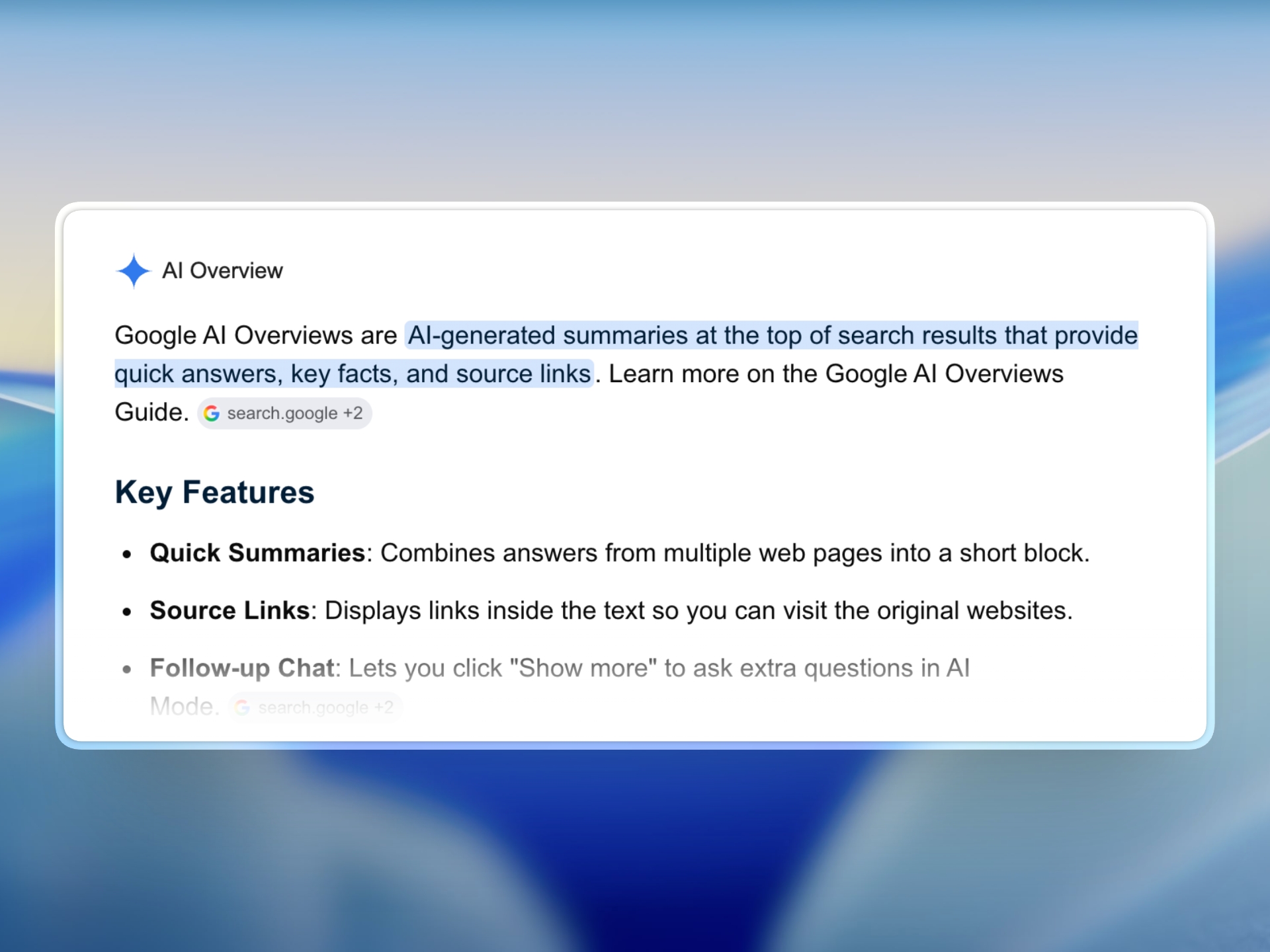
Type a question into Google right now and there is a decent chance the answer shows up before any blue links do. That box at the top, the one with the small AI label, is Google AI Overview, and it is quietly becoming the first and sometimes only thing a searcher reads. If your brand is not named inside it, you did not lose a ranking. You lost the moment entirely, because most people never scroll past it to see the traditional results underneath.
This guide walks through what AI Overview actually is, how to check by hand whether your brand shows up in it, why that manual process breaks down fast, and what a repeatable check looks like once you move past checking once and hoping for the best.
AI Overview is the AI generated summary Google shows above standard search results for a growing share of queries, especially informational and comparison ones. It pulls together information from multiple web pages, writes a short synthesized answer, and usually links out to two or three sources it leaned on most heavily. Those linked sources are the closest thing to a ranking signal that AI Overview gives you. If your page is not one of them, you were not part of the answer, even if you rank on page one below it.
This is different from classic SEO in one important way. A page can rank well and still get skipped by AI Overview, because the summary is not built from rank order. It is built from whichever pages the model judged most useful for answering that specific question, which often means pages with clear structure, direct answers near the top, and enough third party corroboration elsewhere on the web that the model trusts the claim.
The instinct is to open Google, type your brand name or your category, and see what comes up. That tells you almost nothing reliable, for a few reasons.
AI Overview does not appear on every query, even ones that look similar. It shows up for some searches and not others depending on Google's own confidence in giving a synthesized answer, and that can shift week to week without any change on your end.
Results are personalized and location dependent. What you see when logged into your own Google account, from your own browser history and location, is not what a stranger in a different city sees when they ask the same thing.
One search is one data point. Buyers do not ask a single question about your category. They ask it a dozen different ways, comparison questions, use case questions, alternative questions, and your brand might show up in some phrasings and not others. Checking one prompt tells you about that one prompt.
If you want to spot check this without a tool, here is a version that gets you slightly more signal than a random search.
Open an incognito or private browser window so your own history and login are not shaping the results. Search a handful of buyer style questions related to your category, not just your brand name, things like best tool for X, X vs Y, or how to solve a specific problem you address. Note whether an AI Overview box appears at all, and if it does, whether your brand or domain is named in the text or listed as one of the linked sources. Repeat the same set of questions a few days later and compare, since AI Overview answers do shift as Google recrawls and reweighs sources.
Keep a simple log, even a plain spreadsheet, of the question, the date, whether AI Overview appeared, and whether you were mentioned. Without that log you will not be able to tell a real trend from noise.
This works, but it is slow, and it only scales to a handful of prompts before it eats an afternoon. It also only covers Google. It says nothing about whether ChatGPT or Perplexity are naming you for the same questions, and buyers are increasingly starting their research in those tools instead of a search bar.
In most cases the problem is not that your website copy is bad. It is that AI Overview leans heavily on third party corroboration, meaning other sites talking about you, comparing you, or citing you, not just your own homepage saying you are great. If review sites, comparison pages, YouTube videos, and community discussions like Reddit rarely mention your brand, the model has little outside evidence to draw on even if your own pages are well written and technically clean.
The fix is usually a combination of two things. First, make your own pages easy for a model to lift an answer from, meaning a direct answer near the top of the page, clear headings, and simple sentence structure rather than long marketing paragraphs before you ever answer the question. Second, and often more important, build up the third party mentions that AI Overview actually trusts, through genuine coverage, comparisons, and community discussion rather than only your own site.
Bloomiro runs a fixed set of buyer intent prompts against Google AI Overview, ChatGPT, and Perplexity on a schedule, so instead of one manual search you get a repeatable benchmark. It reports whether your brand was named in AI Overview for each tracked prompt, your mention rate over time, which competitors got named or linked instead, which domains AI Overview pulled its sources from, and how that compares week over week as you publish new content or earn new mentions elsewhere.
That turns a one time spot check into an actual measurement loop. You can see whether a new comparison page or a new piece of coverage moved the needle on whether AI Overview starts citing you, instead of guessing based on a single incognito search.
Search buyer style questions related to your category in an incognito window and look for an AI Overview box, then check whether your brand is named in the text or listed as a linked source. For a reliable answer, repeat this across many prompts on a recurring schedule, since a single search is not representative and results shift over time. Tools like Bloomiro automate this by running the same prompt set on a schedule and tracking the results.
AI Overview does not select sources purely by search rank. It favors pages with a clear direct answer near the top and leans heavily on third party corroboration, meaning other sites, reviews, and comparisons that mention you elsewhere on the web. A page can rank on page one and still be skipped if the model has little outside evidence to support what your site claims about itself.
No. It appears for a subset of queries, mostly informational and comparison searches, and Google's decision to show it can change from week to week without any change to the underlying page. This is part of why a single manual check is unreliable and a recurring check across many prompts gives a truer picture.
Yes. Bloomiro's free plan runs AI presence checks against Google AI Overview along with ChatGPT and Perplexity, so you can see whether your brand is mentioned before deciding whether to upgrade for deeper reporting and competitor comparisons.
Normal SEO ranking measures where your page lands in the list of blue links. AI Overview visibility measures whether your brand is named or linked inside the synthesized answer at the top of the page, which is a separate selection process based on how directly a page answers the question and how much outside corroboration exists for the claim, not on rank position alone.
Start with a free homepage check, then connect your site in Bloomiro to track AI mentions, compare competitors, and track actions in Action Center that your team can ship.