Why ChatGPT recommends your competitors (and what to do next)
Updated September 12, 2026
Updated September 12, 2026
You open ChatGPT and ask something your customers actually ask.
It names three brands. None of them is yours.
Or Google shows an AI Overview at the top, and the click-through that used to land on your product page feels thinner. Search Console still shows impressions. Traffic feels softer. A competitor somehow shows up everywhere.
If that sounds familiar, you are not alone. And you do not need another jargon-heavy SEO platform to start fixing it.
Most small marketing teams already have Google Search Console connected. Somewhere. Maybe once a quarter someone screenshots a chart.
What they rarely have is a simple answer to three questions:
Which queries are we almost winning in Google right now?
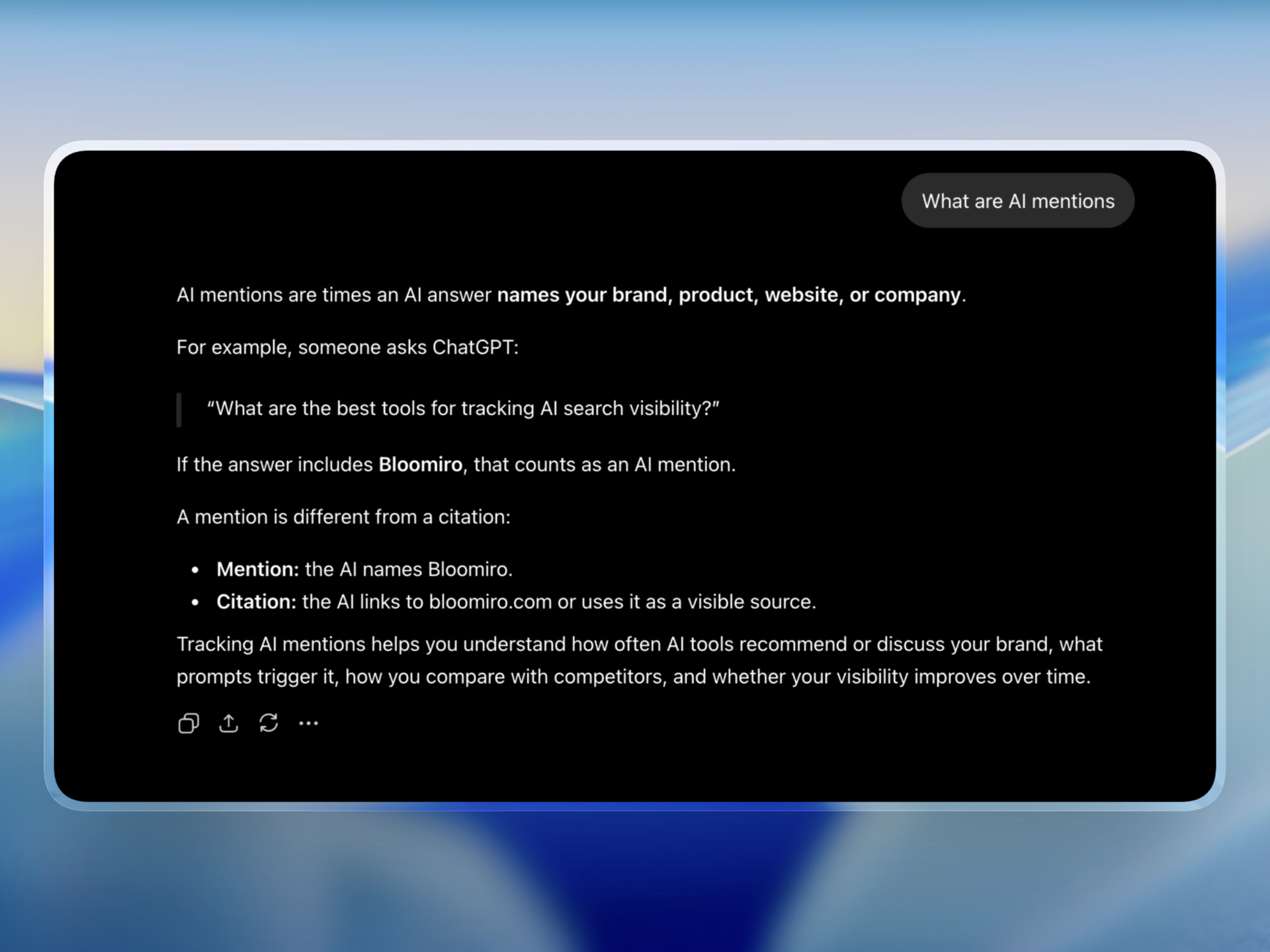
When someone asks ChatGPT (or Gemini, or Perplexity) about our category, do we get mentioned, or does a competitor?
What should we do this week, not someday?
Those gaps are where traffic and trust leak out. Not because your product is weak. Because the web and AI answers reward brands that show up clearly, consistently, and in the places buyers already look.
Here is the kind of picture Search Console, analytics, and AI mention checks often surface for a marketing team. These are illustrative examples, not a snapshot of any one brand.
Google Search Console: Imagine about 200,000 impressions and 10,000 clicks over a month. Plenty of category queries show up in the report, but CTR is soft. You also see long queries like "how to track ChatGPT brand mentions" or "best [your category] for [use case]" with thousands of impressions and almost no clicks.
Near wins: Several money queries sit around positions 8 to 15 with solid impressions. A clearer title, a stronger page, or a missing comparison page could turn those into clicks without inventing a whole new content calendar.
AI answers: On a set of buyer-style prompts, your brand might get named in only a small share of checks, while a competitor shows up far more often. On some prompts you are completely skipped, even though your product fits. Citations lean on YouTube, Reddit, review sites, and competitor pages more than your own site.
Analytics: Say you had about 50,000 sessions last month. Direct and organic still matter, but a growing slice arrives from AI assistants. A few blog posts drive most of the engaged traffic; the rest of the site barely shows up when people ask ChatGPT who to buy from.
Translation: Google can show you almost-winning queries, AI answers can still name someone else, and some visitors already come from AI tools. You need one place that connects those facts to a short weekly list.
Google Search still sends people who are ready to click. Search Console is full of near wins: queries with solid impressions and a ranking that is close but not converting well. Those are often the cheapest wins you have. Refresh a title. Fix a thin page. Build the missing comparison page your competitors already have.
AI answers are the new storefront window. When ChatGPT recommends someone else, that person becomes the default in the buyer’s head before they ever visit a site. You cannot control the model. You can see whether you are mentioned, cited, or skipped, and close the content and proof gaps that make competitors easier to recommend.
You do not need to become an AI SEO engineer. You need one place that shows both layers and turns the noise into a short list.
Bloomiro connects your site so you can see Google Search Console performance and whether ChatGPT and other AI answers mention you or your competitors.
Then it turns the gaps into a prioritized list in Action Center: what to fix, what to create, and what to recheck after you ship.
That is the whole loop.
See which queries and pages already earn traction in Google.
See where AI answers name you, cite you, or recommend someone else.
Compare coverage against competitors so "they win" becomes "they have this page and we do not."
Work from a weekly-style action list instead of a pile of dashboards.
Built for DTC brands, local and multi-location teams, and small marketing squads who wear too many hats. Not for people who want to live inside keyword databases all day.
Monday: Open Action Center. Pick the top two or three items. Usually a near-win query in Search Console, a missing page competitors already cover, or a prompt where you are not mentioned.
Midweek: Ship something small. Title and meta refresh. A clearer FAQ. A hub page for the category buyers keep asking about.
Friday: Recheck the prompts and Search Console traction tied to what you shipped. Mark done. Queue the next items.
You will not win AI overnight. You will stop guessing. That alone is a big upgrade from screenshot culture and last-minute content brainstorms.
This is not a promise that ChatGPT will start recommending you after one blog post. No honest tool can promise that.
It is also not another rank tracker with ten thousand keywords and a sales call attached.
Bloomiro is for marketers who want people to find them: in Google, and in the AI answers buyers already use. Connect the site, see the gaps, act on what matters first.
Connect Search Console, add a couple of competitors and buyer-style prompts, and open Action Center. See if next week’s list feels clearer than last month of guessing.
Related reading: how to track brand mentions in ChatGPT and Perplexity, and how ChatGPT writes brands into its own search.
Usually because competitors have clearer category pages, comparison content, FAQs, and corroborating sources that make them easier to cite or name. Bloomiro shows which tracked prompts mention you, cite you, or name someone else, so you can see the gap instead of guessing from one chat session.
Sometimes AI Overviews take clicks that used to go to classic blue links, especially on informational queries. Find queries where you still earn impressions, improve the pages closest to ranking or converting, and build the missing answers competitors already cover. Bloomiro ties Search Console traction to those next steps in Action Center.
Near wins are queries or pages with meaningful impressions where you are close enough that a small improvement can matter: better titles, clearer pages, stronger internal links, or a dedicated page that does not exist yet. They are often faster than chasing brand-new topics from scratch.
No. If you can connect Google Search Console and read a prioritized checklist, you can use it. The product is aimed at marketers who want visibility and next actions, not developers wiring tools together.
Many SEO tools are great at keyword research and backlink maps. Bloomiro focuses on your Search Console reality plus whether AI answers mention you or competitors, then turns gaps into Action Center tasks. Keep your research stack if you love it. Use Bloomiro when you need what should we do this week across Google and AI answers.
Start with a free homepage check, then connect your site in Bloomiro to track AI mentions, compare competitors, and track actions in Action Center that your team can ship.