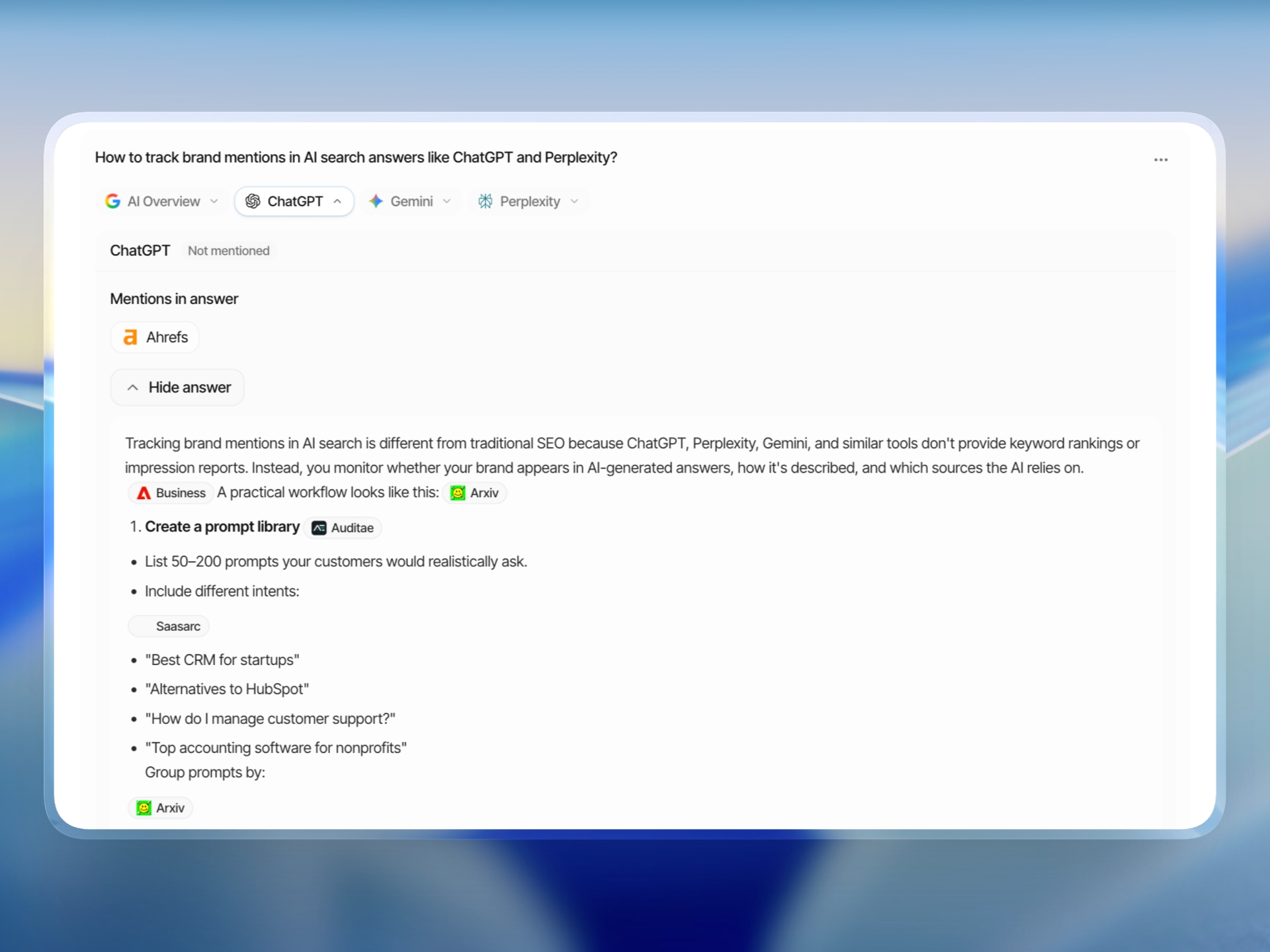
How does Bloomiro measure AI visibility? Saved prompts run on selected answer surfaces; each check records mentions, citations, competitors, and cited URLs at a point in time. It is evidence, not a guarantee of future answers.
Bloomiro measures AI visibility as a set of repeatable observations. Each observation is one saved prompt, sent to one selected AI answer surface for one prompt-group locale, at a recorded point in time.
The result is evidence about what that surface returned for that check. It is not an estimate of total audience reach, market share, or the probability that every user will see the same answer.
Methodology at a glance
- A user saves prompts in a prompt group or reviews AI-generated suggestions before saving them.
- The user selects active prompts and one or more supported answer surfaces.
- Bloomiro submits the exact saved prompt text with the prompt group's language and country settings where the provider supports them.
- Bloomiro records the returned answer, detected brand mention, tracked competitor appearances, cited source URLs, and an optional sentiment score.
- Run-level scores are calculated from completed prompt-by-provider checks and the prompts selected for that run.
Bloomiro keeps prompt-level and provider-level results available so a percentage can be checked against the underlying answers.
How prompts are chosen
Bloomiro does not claim that one prompt set represents every question a market asks. The prompt set belongs to the project and is visible to the user.
Prompts can come from two sources:
- User-written prompts: a user can add, edit, disable, or remove exact prompt text.
- AI-generated suggestions: Bloomiro can suggest prompts after a site crawl has produced a visibility profile. The generator uses available project context such as company category, audience, positioning, keyword themes, selected competitors, prompt-group language, existing prompts, and optional user instructions.
Generated suggestions are designed to sound like plausible buyer questions. They can cover category discovery, comparisons, use cases, problems, broad discovery, narrow needs, and buyer intent. The generator is instructed to keep most suggestions category-led or decision-led instead of filling the set with the monitored brand name.
Suggestions are not search-volume data and are not automatically proof of buyer demand. Users should review them for relevance before using them as a benchmark.
A prompt group can store up to 50 prompts. A single run accepts up to 25 prompts. Unless specific prompt IDs are selected, a run uses the active prompts in its chosen scope.
Language and location
Language and country are saved per prompt group. English for the United States is the default. The selected locale is used for prompt generation and is passed to provider requests where that answer surface supports language or country inputs.
Locale handling is not identical across providers. A locale setting can influence a result, but it does not guarantee that every provider will localize an answer in the same way.
Supported AI answer surfaces
Bloomiro currently supports these provider surfaces:
All supported surfaces are included in the Starter, Builder, and Growth plans. Runs use credits based on the number of prompt-by-provider checks.
All six can be selected for a run. The default selection is ChatGPT, Gemini, Perplexity, and Google AI Overview. Provider availability can vary with upstream access and configuration.
The provider name identifies the answer surface checked. Bloomiro does not claim to identify or control every underlying model version, experiment, retrieval system, or ranking change used by that provider.
How a check is collected
Bloomiro runs each selected prompt against the supported answer surfaces. A check stores the returned answer along with structured source data when available. Full response data is stored separately from smaller run metadata.
One check is one captured response. Bloomiro does not average multiple responses for the same prompt and provider inside a single run.
Checks are asynchronous and can take several minutes. A check can fail because an upstream provider, dataset, network request, or returned response is unavailable or unusable. Bloomiro records failed checks rather than presenting them as completed observations.
What counts as a brand mention
A brand mention is recorded when the returned answer prose contains a recognized brand name alias.
Bloomiro builds aliases from the project's company name and website host. Matching is case-insensitive and uses token boundaries for normal word aliases. The detector removes raw URLs, known citation-link targets, bare tracked domains, and trailing source or reference sections before looking for a prose mention.
This distinction is intentional:
- A brand name in the answer prose can count as a mention.
- A link to the brand's site does not count as a mention by itself.
- A brand name that appears only as citation anchor text does not count as a prose mention.
- A citation can exist without a mention, and a mention can exist without a citation.
Alias detection can still produce false positives or false negatives, especially for short, generic, ambiguous, punctuated, or unusually styled brand names. The captured answer should be reviewed when a result matters.
What counts as a citation
A citation is a source URL identified in a provider's structured source or citation fields, or an explicit source URL found in the returned answer. Bloomiro filters invalid URLs and known provider or platform hosts that are not treated as independent sources.
A brand citation is present when a cited source hostname matches the project's website hostname or one of its subdomains.
The run-level brand citation count is the number of completed prompt-by-provider checks that cite the brand at least once. It is not the total number of brand URLs, links, or repeated citations in the answers.
Organic result URLs returned alongside an answer can be stored as additional URLs, but they are not automatically counted as citations unless the provider marks them as cited or they appear as explicit source URLs in the answer.
How competitors are detected
Competitor mentions are limited to competitors saved for the project. Bloomiro records a competitor mention only when a recognized competitor name appears in answer prose (after citation artifacts are stripped).
Competitor citations are separate: when a cited source hostname matches a tracked competitor domain, that counts as a citation, not a mention. A competitor can be cited without being named, and named without being cited.
Competitor detection does not attempt to discover every company mentioned in an answer, and it should not be interpreted as complete market coverage.
How AI visibility scores are calculated
Bloomiro reports several measurements because they answer different questions.
| Measurement | Calculation | Meaning |
|---|
| Visibility score | Prompts with at least one completed brand mention ÷ prompts selected for the run × 100 | The share of selected prompts where the brand appeared on at least one selected provider |
| Mention rate | Completed checks with a brand mention ÷ all completed checks × 100 | The share of completed prompt-by-provider observations that mentioned the brand |
| Sentiment score | Mean 0–100 tone score across mentioned checks with a valid sentiment result | The average detected tone toward the brand, where 0 is very negative, 50 is neutral, and 100 is very positive |
| Brand citations | Count of completed checks with at least one citation to the project hostname or a subdomain | How many completed observations cited the brand's site |
Scores are rounded to two decimal places in stored run statistics. Some dashboard displays round them to whole percentages.
Visibility score example
If a run contains 10 prompts and the brand is mentioned by at least one selected provider for 4 of those prompts, the visibility score is 40 percent. A prompt still counts once when several providers mention the brand.
Mention rate example
If 36 prompt-by-provider checks complete and 9 mention the brand, the mention rate is 25 percent.
Failed-check treatment
Mention rate uses completed checks only. Failed and cancelled checks are excluded from its denominator.
Visibility score uses all prompts selected for the run as its denominator. A prompt with no completed mentioning result is not counted as mentioned, including when all of its provider checks fail. For this reason, review check status before comparing visibility scores from runs with failures.
Sentiment scoring
Sentiment is calculated only after a prose mention is detected. Bloomiro sends up to three sentences containing the detected brand mention to its configured language model and requests a 0–100 tone score. Invalid or unavailable scores are stored as no sentiment result. Run sentiment is the average of the valid result-level scores, not a measure of general public opinion.
How changes between runs are calculated
Visibility, mention-rate, and sentiment deltas compare the current run with the most recent earlier completed run in the same prompt-group scope. Prompt-level gained and lost mentions are also compared with that prior completed run.
The comparison does not require both runs to contain an identical prompt set or identical providers. Adding prompts, removing prompts, changing providers, editing prompt text, or changing locale can change a score even if the brand's real-world visibility has not changed. For a useful trend, keep the measured set stable.
Update frequency
AI presence data is updated when a user starts a run from the Bloomiro dashboard or through MCP. The current product does not automatically start AI visibility runs on a fixed daily or weekly schedule.
The latest score updates after a run finishes. Bloomiro has recovery processing for interrupted or slow provider jobs, but recovery continues an existing run and does not create a new measurement observation.
For comparable monitoring, rerun the same active prompts, providers, and locale at a cadence that matches the decision being monitored. A weekly or monthly cadence can be useful, but it is a user choice, not a Bloomiro claim that the data refreshes automatically.
Limitations
- Answers vary: AI providers can return different answers for the same prompt because of model updates, retrieval changes, experiments, timing, location, and other provider-controlled factors.
- One response per check: a run captures one response for each prompt and provider combination, not a distribution of possible answers.
- No audience weighting: prompts are not weighted by search volume, traffic, revenue, or estimated buyer frequency.
- No universal market-share claim: the scores describe the selected prompt set and providers only.
- Provider versions are not controlled: Bloomiro identifies the checked answer surface, not every hidden model or experiment behind it.
- Citation formats differ: source extraction depends on the fields and answer formats returned by each provider dataset.
- Alias matching is imperfect: ambiguous brand names can require manual review.
- Failures affect comparability: failed checks can reduce the evidence available and can affect visibility score as described above.
- Locale support differs: not every provider uses the same language and country controls.
- No causal proof: a gained mention or citation does not prove that one page change caused it.
- No guarantee: Bloomiro cannot guarantee a future mention, citation, recommendation, ranking, or business result.
How to use the data responsibly
For a defensible comparison:
- Choose prompts that reflect real category, use-case, comparison, and buyer questions.
- Review generated suggestions and remove weak or irrelevant prompts.
- Keep prompt text, selected providers, and locale stable across comparison runs.
- Check failure status before interpreting a change.
- Read the captured answers and cited sources behind important scores.
- Treat movement as an observed signal that deserves investigation, not proof of cause.
Use AI visibility alongside Google Search Console, site and page evidence, competitor research, and professional judgment. Learn how the broader workflow fits together on What is Bloomiro? and the AI search visibility platform page.
Methodology update policy
This page was last updated on July 13, 2026. Bloomiro updates this page when the implemented measurement method changes in a way that affects interpretation. There is no fixed editorial update calendar. The date above should be used to judge whether this description matches a later product version.