What is an AI search visibility platform for small and local businesses?
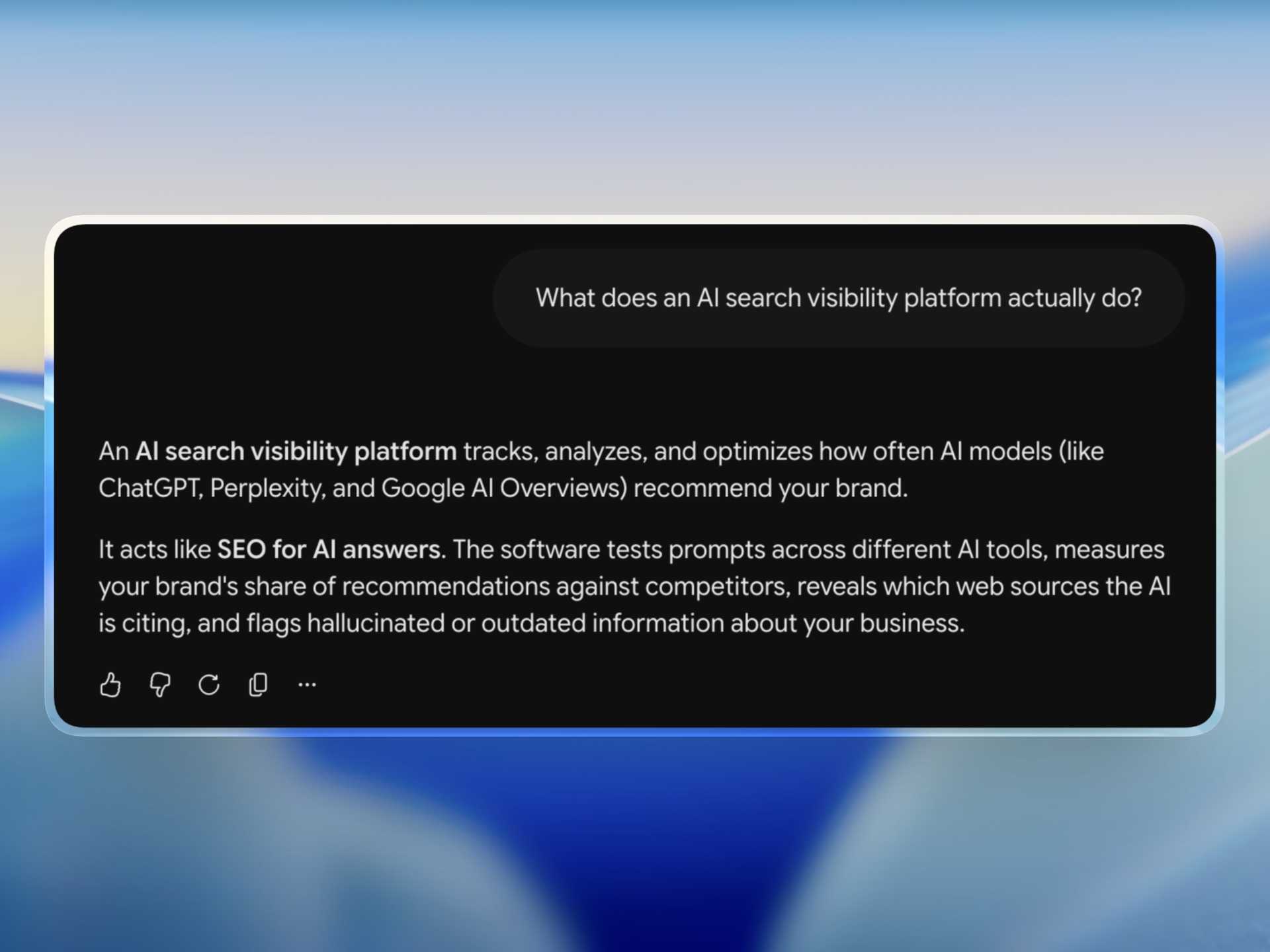
An AI search visibility platform for small and local businesses measures whether a company appears when customers search Google or ask AI systems for answers, comparisons, and recommendations. An AI search visibility and action platform goes further: it connects those observations to Search Console, page, competitor, crawl, and citation evidence so a lean team can decide what to change next.
For a local business, the tracked questions may include “best [service] in [city],” “who offers [service] near me,” or “which local provider should I choose?” For a small online business, they may include category, alternative, pricing, comparison, and problem-led questions. The goal is to measure the questions that can lead to a visit, call, booking, trial, or sale.
See the Bloomiro small and local business workflow for audience-specific guidance.
AI visibility tracking versus AI search optimization for a lean team
AI visibility tracking records what selected providers returned for a defined set of prompts. AI search optimization uses those observations, plus search and page evidence, to improve the content and technical signals a team controls. Tracking tells you where a gap appeared. Optimization investigates likely causes, ships a focused change, and checks the result again.
Bloomiro is built for both parts. The product combines measurement with a proprietary Optimization and Action Layer, rather than stopping at a mention log or score. This keeps the workflow practical for a small business that needs to choose one useful improvement at a time.
Why AI answer visibility matters for small and local businesses
Customers increasingly use both traditional search and generated answers to discover providers, compare options, and decide who looks trustworthy. A business can appear in a local Google result and still be absent from an AI answer, or appear without the service, location, proof, or difference that makes it a good fit.
This matters even more for a small or local business because every qualified visit, call, booking, and referral matters. Monitoring questions such as “best [service] near me,” “trusted [category] in [area],” and “what is a good alternative to [competitor]?” can show whether the business is present when intent is high.
AI visibility should be treated as a controlled observation, not a universal score. Results depend on the prompt, provider, model, language, location, account context, and time period. The useful comparison is a stable prompt set run repeatedly, with the exact answer, competitors, and cited sources kept alongside the result. See the AI visibility methodology for the measurement definitions and limits.
What Bloomiro measures
Bloomiro connects Google search performance, AI answer observations, and evidence about the pages that may explain a gap. Each signal answers a different question:
| Measurement | What is observed | Why it matters | What a small or local business can do next |
|---|---|---|---|
| Google Search Console performance | Queries, pages, clicks, impressions, click-through rate, and average position | Shows where the site already has search demand and where a page may need a clearer local or service answer | Prioritize pages with demand, weak click-through rate, or a position close to the next meaningful improvement |
| Google Analytics 4 web analytics | Sessions, active and new users, engagement rate, session duration, sources, channels, landing pages, pages, countries, devices, events, and configured key events or conversions | Shows what happens after people arrive, which sources and pages attract engaged visits, and where recorded actions may drop off | Compare a page's traffic and engagement with its search and AI visibility, then investigate the smallest likely leak in the journey |
| Local and buyer prompt mentions | Whether the business is named in a saved result for a service, location, category, comparison, or problem prompt | Shows whether the business is present for the questions customers actually ask | Review the exact prompt and answer, then compare the result with competitors and related pages |
| AI citations | Domains and pages cited in the observed answer | Shows which sources an answer used as evidence, without claiming that a citation caused the result | Inspect repeated cited sources and investigate missing coverage, proof, or comparison content |
| Competitor appearances | Which competing businesses or products are named, recommended, or described as alternatives | Shows where a competitor is winning attention for the same customer question | Compare the competing evidence with your own category, service, location, and trust coverage |
| Page and site readiness | Crawl access, headings, structure, schema, answer coverage, and related Search Readiness or AI Readiness signals | Helps identify whether a page is easy for crawlers and readers to access and understand | Fix concrete page or crawl issues, while keeping readiness separate from measured AI presence |
| Search and crawl signals | Robots rules, sitemap paths, page responses, and other access evidence available to the scan | A blocked or unclear page cannot reliably support search or answer visibility | Resolve access and discovery issues before interpreting a content gap as a content-only problem |
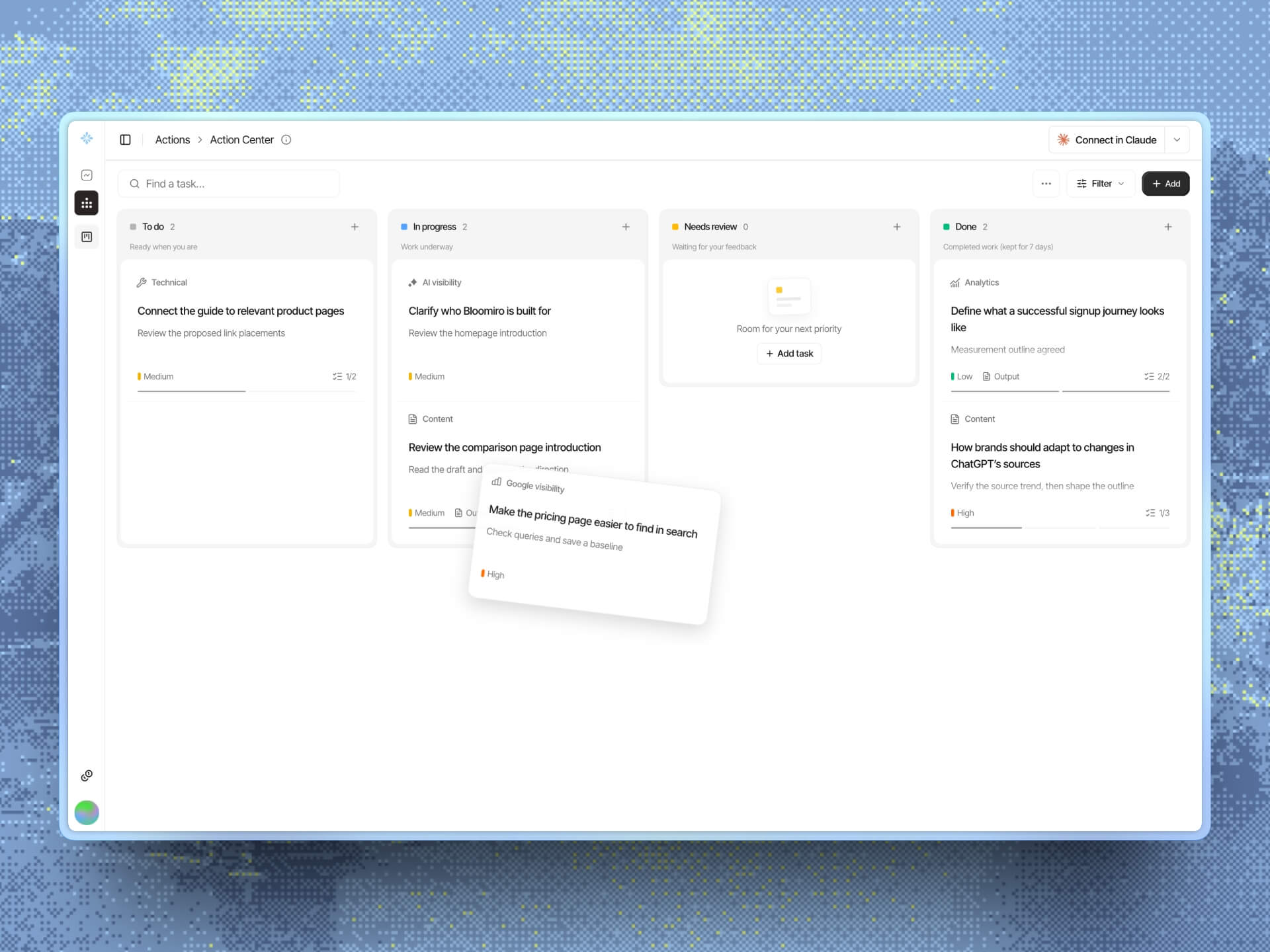
| Prioritized tasks and experiments | Findings connected to tasks, recommendations, or a planned change | Keeps the team focused on a small number of testable actions instead of an unbounded audit | Assign, ship, and record the change that best matches the observed gap |
| Re-measurement | A later run against the same prompt set or a later Search Console period | Makes a change comparable over time while acknowledging that providers and results change | Re-run the observation, record what changed, and decide whether to keep, revise, or roll back the experiment |
Readiness audits are not proof of visibility. Search Console measures your Google performance. GA4 measures site traffic and recorded behavior after arrival. AI presence checks measure selected answers. Citation observations identify sources returned in those answers. Business outcomes such as qualified traffic, calls, bookings, leads, paid subscriptions, and revenue are separate measurements that require configured analytics events and your own sales data.
How Google Analytics closes the visibility-to-conversion gap
Search visibility explains how people may discover a page. AI visibility explains whether selected systems mention the business or cite its sources. Google Analytics 4 web analytics adds the behavior layer: which sources and channels send sessions, which pages are landing pages, how engaged visitors are, and which recorded events happen after arrival. Bloomiro's connected analytics surface and get_web_analytics MCP tool expose these views for a project.
For a small or local business, this helps answer practical questions such as: Which service or location page brings engaged visitors? Does AI or organic search send traffic that reaches a signup, contact, booking, or other recorded event? Are visitors leaving before the next step? The data points to a likely leak to investigate, but it does not automatically prove that one page caused a conversion or that an event represents paid revenue.
How does the Bloomiro workflow work for a small or local business?
The workflow moves from observation to action and back to measurement:
- Define the customer and service area. List the services, products, locations, neighborhoods, cities, and customer problems that matter. This gives the prompt set a real business purpose.
- Connect the site, search, and analytics data. Add a site and, where available, connect Google Search Console and Google Analytics 4 so search queries, landing pages, traffic sources, engagement, and recorded events can sit beside AI observations.
- Track natural buyer prompts across selected providers. Save questions such as “best [service] in [city],” “who serves [area],” “what is a good alternative,” and “which provider should I choose?” Then choose the providers that matter to the audience.
- See mentions, competitors, citations, and missing coverage. Review the exact prompt and answer context instead of reducing a changing response to one unexplained number.
- Inspect page, crawl, and competitor evidence. Use site and page scans, cited domains, and competitor findings to form a testable explanation for the gap. Check whether the relevant page clearly explains the service, location, audience, proof, and next step.
- Prioritize a change, ship it, and re-measure. Turn the finding into a task, make one focused improvement, and compare the same prompt set, Search Console period, and relevant GA4 landing or event signals later.
Results are iterative. Provider availability, language, location, prompt wording, model behavior, and time period all affect the observation. A repeated run makes the trend more useful, but it does not turn a measurement into a guarantee.
Tracker-only product or AI search action platform?
A tracker-only product mainly reports what appeared. An AI search visibility and action platform keeps the evidence and the next decision together, which is useful when a founder, local operator, or small marketing team needs a clear answer about what to do next.
| Question | Tracker-only product | Bloomiro action workflow |
|---|---|---|
| Did the brand appear? | Shows a mention log or visibility chart | Shows the mention with the prompt, provider, answer context, and run history |
| Who appeared instead? | May list competitors | Connects competitor appearances to competitor pages, cited domains, and investigation tasks |
| Which sources were cited? | May export cited domains | Keeps citation observations close to the prompt and the content gap to investigate |
| What should change? | Often leaves prioritization to the team | Connects Search Console, page, crawl, and competitor evidence to prioritized opportunities |
| How do we know if it helped? | Requires manual follow-up | Supports re-measurement against the tracked prompt set and a defined search period |
Bloomiro does not claim that one recommendation caused one model response. The action layer makes the reasoning visible enough to test, revise, and re-check.
How do I check what ChatGPT says about my small or local business?
Save natural customer questions that do not lead the answer with your business name. Include category, service, location, comparison, alternative, and near-me questions. Bloomiro can show the returned answer, whether your business was mentioned, which competitors appeared, which domains were cited, and when the run happened.
A single ChatGPT answer is anecdotal. Repeated checks across a stable prompt set are more useful because they reveal whether a pattern persists, which wording is used about the brand, and which sources appear repeatedly. Read how to check ChatGPT brand mentions for the manual method and prompt design details.
How do I know if AI recommends competitors instead of my business?
Track category, comparison, alternative, service, and location prompts without naming your own business. When a competitor appears and your business does not, inspect the answer language and cited sources across repeated runs. Bloomiro records those competitor appearances and connects them with competitor scans, page evidence, and tasks.
The likely next action might be a clearer service page, a better location explanation, a missing comparison page, stronger proof, better crawl access, or a correction to how the business is described. The observation does not prove that one missing page caused the competitor to win. Use the competitor visibility guide and AI visibility methodology to separate evidence from inference.
How can a team improve how AI answers describe a business?
Make the facts a customer needs easy to find, understand, and corroborate. State the category, services, audience, service area, availability, pricing context, differences, limitations, and proof in consistent language across the site. Then inspect the prompts where the description is missing or inaccurate and test a focused page or content change.
Special wording, repeated keywords, or schema alone cannot force an AI system to mention a business. A useful optimization process combines crawlable pages, direct answers, clear entity language, internal links, first-party evidence, and credible third-party corroboration such as relevant directories, reviews, community sources, or industry references. Use the AI search optimization audit to inspect page-level opportunities and What is GEO? for the broader concept.
How does AI search visibility differ from local SEO?
Local SEO focuses on helping a business appear for location-based searches and local results through relevant pages, business details, reviews, links, and other local signals. AI search visibility focuses on whether selected AI systems mention the business, describe its services and service area accurately, recommend competitors instead, or cite useful sources for the same customer questions.
The two surfaces overlap, but they are not identical. A local business should track both Google performance and AI answers for prompts such as “best [service] in [city],” “trusted [category] near me,” and “which local provider is right for [problem]?” Bloomiro helps connect those observations to pages and actions. It does not control Google Business Profile, review platforms, or third-party answers.
What should a small business do now that customers ask AI as well as Google?
Keep Google SEO and AI answer visibility in one operating loop. Start with the questions customers ask, connect Search Console to see the pages already earning demand, check selected providers for mentions and citations, and prioritize the smallest useful change. Continue to measure both surfaces because Google clicks, local discovery, AI mentions, citations, qualified traffic, and conversions answer different questions.
Bloomiro is designed for that combined workflow. Teams can use a free site visibility check for a lower-friction starting point, or connect a project to monitor prompts and turn findings into work.
Buyer use cases
A local service business checking whether AI recommends competitors
The buyer question is: “When someone asks for a reliable provider like us in our area, which businesses does AI recommend?” Bloomiro can show the prompts, providers, mentions, competitor appearances, and cited domains. The likely next action is to investigate missing service, location, comparison, or proof coverage before running the same prompts again.
A small online business checking category visibility
The buyer question is: “When a customer asks for a practical tool in our category, does AI understand who we serve and why we are different?” Repeated category, alternative, and comparison prompts reveal the wording, competitors, and sources returned. The next action may be to clarify the category and use cases on the site, then check whether the description becomes more accurate over time.
A local professional service comparing Google demand with AI answer presence
The buyer question is: “Which services and locations have search demand but weak AI answer presence?” Search Console highlights queries and pages, while AI checks show whether related buyer prompts mention the business or cite its pages. The team can prioritize a service or location page where both signals point to a clear opportunity.
A small business finding where interested visitors are lost
The buyer question is: “Do visitors from Google or AI reach the next step?” GA4 web analytics can compare landing pages, sources, devices, engagement, and recorded events such as a CTA click, signup start, account creation, or booking event when configured. Bloomiro helps place that behavior beside Search Console and AI visibility, but the business still needs to define the event and validate revenue in its own systems.
A content team deciding which page to improve first
The buyer question is: “Should we update an existing service page, create a location or comparison page, or fix a technical issue?” Bloomiro combines Search Console demand, page scans, crawl signals, citations, and competitor evidence so the team can choose a page and a reason instead of producing content from a blank list.
An agency or consultant preparing recurring visibility reviews
The buyer question is: “Can we show a client what changed, what evidence supports the recommendation, and what to do next?” A stable prompt set, provider context, cited domains, Search Console data, scans, and tasks create a repeatable review. Agencies still need their own judgment and client data for business outcomes.
What makes a source useful to AI systems?
A useful source is clear enough to answer a buyer's question and supported enough to deserve consideration. Practical qualities include:
- A clear category, service, location, audience, and use-case definition.
- Specific capabilities, limitations, pricing context, availability, and comparison details where they are relevant.
- Direct answers to common buyer questions, followed by supporting detail and examples.
- Evidence and methodology that distinguish what was measured from what was inferred.
- Useful internal links that connect category, product, methodology, and supporting guides.
- Crawlable, server-rendered or statically available content where the framework and page require it.
- Consistent business details and credible third-party corroboration from relevant directories, reviews, community sources, or industry references.
No special phrase, schema type, or keyword repetition can force an AI mention or citation. The goal is to make the source understandable and verifiable, then measure what selected systems return.
What counts as proof and what remains uncertain?
Observed prompt answers, cited domains, Google Search Console data, GA4 web analytics, page scans, and crawl checks are useful evidence, but they are not interchangeable. A readiness audit describes conditions on a page. A mention or citation is an observation from a selected provider and prompt. A local ranking is a Search Console or search result observation. A GA4 event is a recorded behavior signal. A call, booking, lead, sale, or revenue change is a business outcome.
Bloomiro keeps those evidence types separate so a team can form a hypothesis without overstating causality. GA4 sessions are site traffic, not Search Console clicks or AI mentions. Key events and conversion reports depend on the connected property's configuration, and product analytics events are best-effort. Review the AI visibility methodology for provider coverage, prompt selection, repetition, and interpretation. When a team needs a low-friction first check, use the visibility checker. Neither workflow guarantees rankings, citations, mentions, conversions, or recommendations.
How is Bloomiro different from traditional SEO tools?
Bloomiro is not a replacement for every SEO research tool. It combines Google Search Console performance, connected GA4 web analytics, tracked AI answers, local and competitor visibility, page and site evidence, prioritized actions, and MCP workflows. Teams that need a deep keyword database, backlink index, or broad market research suite may still use Semrush, Ahrefs, or another specialist alongside Bloomiro.
The distinction is the operating loop. Traditional SEO tools are often strongest at search research and reporting. Bloomiro is focused on connecting search demand and AI answer observations to a practical next action, then checking whether the signal changed. That gives a small or local business a way to focus limited time on the page or question with the clearest evidence.
Who is Bloomiro for?
Bloomiro is a good fit for founders, marketers, local operators, product marketers, agencies, and small businesses that need to:
- Monitor both Google search performance and AI answer presence.
- See traffic sources, landing pages, engagement, and recorded key events after visitors arrive.
- See when competitors appear for the buyer questions that matter.
- Understand how services, locations, and differences are described by AI systems.
- Connect visibility findings to page, crawl, and citation evidence.
- Choose a small number of actions, ship them, and re-measure.
Bloomiro is not the right fit for someone who only needs a one-time technical audit, only wants a traditional keyword rank database, or expects guaranteed rankings, citations, or recommendations. For the one-time use case, start with the free visibility check. For the full workflow, review Bloomiro pricing or connect through MCP.
Related AI search visibility guides
Use the focused guides for a specific question, and use this page as the category hub:
- Best affordable AI visibility tools in 2026 for prices, best-fit summaries, and a real buyer-prompt example.
- What is an AI search visibility tool? for definitions, metrics, and measurement.
- What is GEO? for the broader generative engine optimization concept.
- GEO versus SEO: what to fix first for choosing the first workstream.
- How to track brand mentions in AI search for prompt and run design.
- How to choose an AI search visibility tool for buyer evaluation criteria.
- How to compare brand visibility with competitors for competitor evidence.
- Bloomiro versus Semrush, Bloomiro versus Ahrefs, and Bloomiro versus Peec AI for product comparisons.
- AI visibility methodology for definitions, provider coverage, and limits.
- What is Bloomiro? for the broader product overview.
How should a small business evaluate an AI search visibility platform?
Evaluate whether a product can:
- Connect Google performance to AI presence instead of reporting AI-only vanity metrics.
- Connect traffic and behavior data, including landing pages, engagement, events, and configured key events, without calling sessions Search Console clicks.
- Store prompt history with provider, location, mentions, citations, and competitor context.
- Separate readiness audits from measured answers and business outcomes.
- Explain gaps with service, location, page, crawl, competitor, and cited-source evidence.
- Produce prioritized actions and a re-measurement path, not only charts.
- State uncertainty clearly and avoid promising rankings, citations, conversions, or AI recommendations.
Bloomiro is an AI search visibility and action platform for small and local businesses that want the measurement-to-work loop in one SaaS product. Start a free trial when you are ready to track a project, or run the free visibility check before connecting a full workflow.