Google AI Overview Citations vs Organic Rankings: What 2,161 Citations Show
Updated August 26, 2026
Updated August 26, 2026
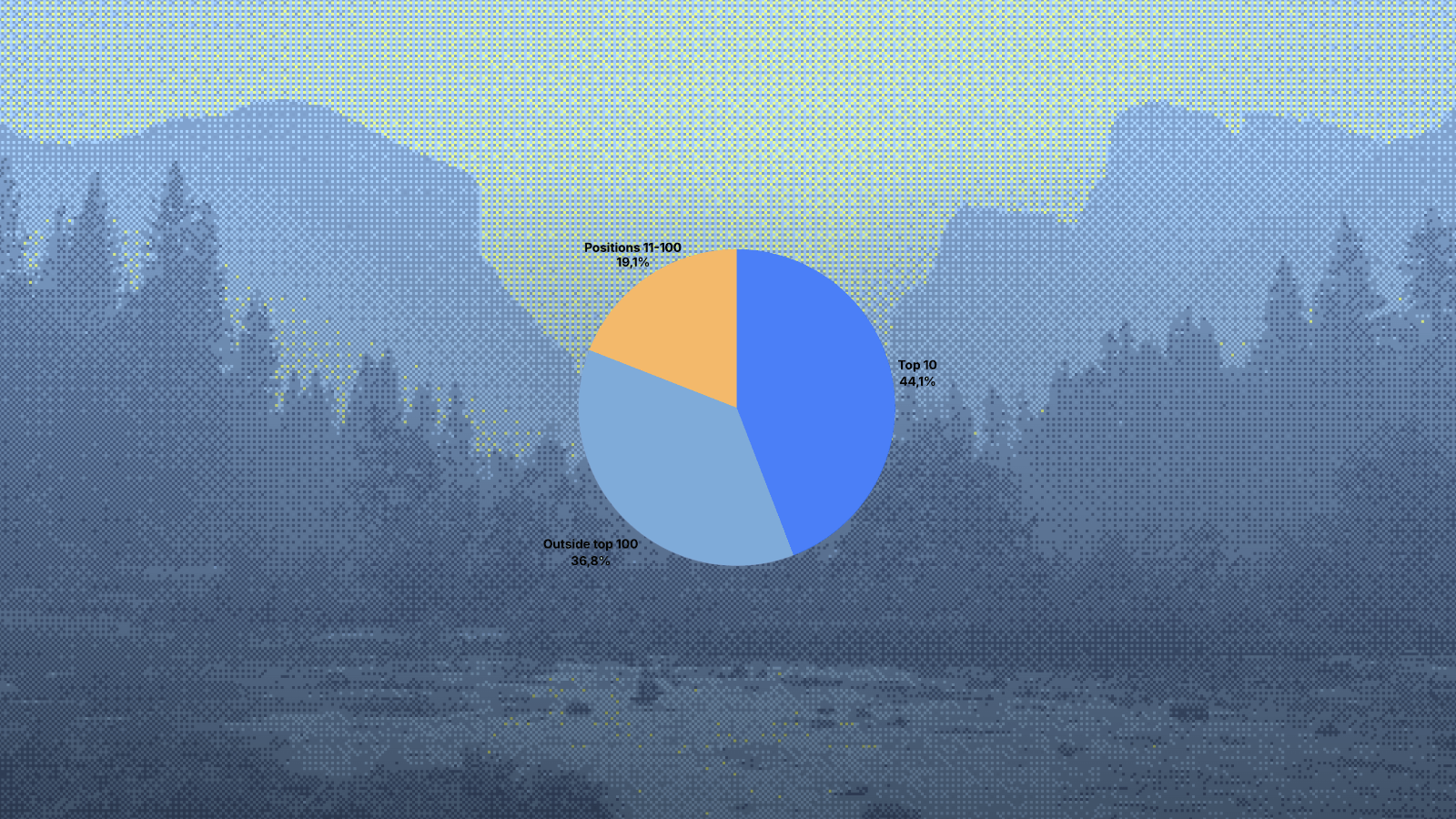
Do pages need to rank on the first page of Google before they can be cited in AI search?
We analyzed 2,161 citations and compared each cited page with its organic Google ranking. The result shows a clear relationship between SEO visibility and AI citations, but it also shows that the two are not the same thing.
Only 44.1% of citations came from pages ranking in Google's organic top 10. The remaining 55.9% came from pages outside the top 10.
Most strikingly, 36.8% of all citations came from pages that did not rank in the organic top 100.
| Organic Google position | Citations | Share |
|---|---|---|
| Top 10 | 954 | 44.1% |
| Positions 11 to 100 | 412 | 19.1% |
| Outside the top 100 | 795 | 36.8% |
| Total | 2,161 | 100% |
The main takeaway is simple. 1,207 of 2,161 citations came from pages outside Google's organic top 10.
We also looked at domain-level patterns across the dataset. This sample mixes SaaS companies, startups, and local businesses, so the domain distribution should be read as a description of this dataset, not as a universal ranking of the websites Google AI Overviews cite most often.
| Domain | AIO cited count | Organic presence count | Observed count | AIO ratio |
|---|---|---|---|---|
| youtube.com | 110 | 66 | 166 | 0.66 |
| reddit.com | 71 | 168 | 187 | 0.38 |
| instagram.com | 62 | 76 | 151 | 0.41 |
YouTube stands out in this sample. It recorded 110 AIO-cited instances against an observed count of 166, giving it a ratio of 0.66. Reddit recorded 71 against 187, or 0.38. Instagram recorded 62 against 151, or 0.41.
Instagram needs extra context. Because the study combines SaaS and startup queries with local-business queries, Instagram can be more prominent than it would be in a purely B2B SaaS dataset. Local businesses often have strong social profiles, visual content, location signals, and brand information on Instagram. That sample composition can influence which domains appear frequently.
The broader point is not that every site should prioritize Instagram, YouTube, or Reddit equally. It is that Google AI Overviews can draw from source types that do not look like a conventional list of ten blue links. The domains that matter depend on the query category and the information Google needs to support the answer.
The largest single group was made up of pages that already ranked on Google's first page.
We found 954 citations from top 10 pages, equal to 44.1% of the total.
This suggests that strong organic performance still matters. Pages that rank well have already demonstrated relevance and usefulness for a topic. It makes sense that many of those pages also become sources for AI-generated answers.
But if AI citation selection simply mirrored the organic results, we would expect most citations to come from the first page. They do not.
Another 412 citations, or 19.1%, came from pages ranking somewhere between positions 11 and 100.
These pages were visible to Google, but they were not first-page results for the queries we compared.
That matters because a traditional rank tracker might label a page in position 36 or 72 as a weak performer. Yet that same page can still contain information that an AI system decides is useful enough to cite.
Organic ranking is therefore a useful signal, but it is not a complete measure of AI citation visibility.
This was the most surprising result in the study.
We found 795 citations pointing to pages that did not rank in the organic top 100 for the search result we checked. That is 36.8% of all citations.
More than one in three cited pages would have been almost invisible in a conventional ranking report.
This shows why teams should not use organic rankings as a proxy for AI visibility. AI systems can retrieve and cite useful information from sources that are not prominent in the normal search results.
Our data suggests yes, but ranking is not a requirement.
The top 10 was still the largest citation bucket, so SEO remains important. A page that performs well organically is likely to have many of the qualities that also help with citation eligibility.
The important part is what happens outside that bucket. Since 55.9% of citations came from outside the organic top 10, there is clearly more happening than a simple copy of Google's first page.
For marketers, this means SEO and AI search optimization should be measured together, but not treated as the same discipline.
An AI answer does not always need the single best page for an entire topic. It may need one useful fact, a definition, a statistic, a comparison, a video, a community discussion, or a local source that supports one part of the answer.
That creates a different retrieval problem from ranking ten webpages in order.
One source may provide the definition. Another may supply a number. A third may offer first-hand experience. A fourth may contain original research. This helps explain why the citation layer can look different from the organic result set.
The findings do not suggest abandoning traditional SEO. They suggest expanding what you measure.
Keep improving organic rankings. The top 10 still produced the largest individual share of citations.
Measure citations separately. A page can perform poorly in a rank tracker and still be selected as an AI source.
Publish information worth citing. Original statistics, research, comparisons, definitions, and first-party data give AI systems concrete material to reference.
Consider the source ecosystem for your category. A SaaS query, a local-business query, and a consumer query can surface very different domains.
Do not generalize one domain mix to every market. The Instagram result in this study is a good example of why sample composition matters.
The numbers in this study are specific findings, not rewritten definitions:
2,161 citations analyzed
954 citations from top 10 pages
412 citations from positions 11 to 100
795 citations from outside the organic top 100
55.9% of citations came from outside the organic top 10
That is useful because original research gives search engines, publishers, and AI systems something distinct to reference. If every article simply rewrites what is already ranking, there is less reason to choose that page as evidence.
The most important number in the study is 55.9%.
More than half of the citations we analyzed came from URLs outside Google's organic top 10, and 36.8% came from pages outside the organic top 100 entirely.
Traditional SEO remains important, but AI citation visibility extends beyond page one. The domain-level results reinforce the same idea. Sources such as YouTube, Reddit, and Instagram can appear prominently depending on the query mix, and local-business queries can shift that source distribution substantially.
A rank tracker can tell you where a URL appears in organic search. It cannot, by itself, tell you whether that page is being used as evidence inside an AI-generated answer.
No. In our analysis of 2,161 citations, 44.1% came from pages in Google's organic top 10, while 55.9% came from pages outside the top 10.
36.8% of the citations in our study, or 795 out of 2,161, pointed to pages that did not rank in the organic top 100.
YouTube, Reddit, and Instagram were among the notable domains in the domain-level analysis. The sample mixes SaaS companies, startups, and local businesses, so these figures describe this dataset rather than a universal ranking of Google AI Overview sources.
The dataset includes local-business queries as well as SaaS and startup queries. Local businesses often have strong Instagram profiles and visual or location-oriented content, which can increase Instagram's presence in a mixed sample.
Yes. Top 10 pages were the largest individual citation group in the study. However, strong rankings were not required because more than half of all citations came from outside the top 10.
Start with a free homepage check, then connect your site in Bloomiro to track AI mentions, compare competitors, and track actions in Action Center that your team can ship.