Why does YouTube get cited in AI answers? AI systems often use video transcripts, titles, and descriptions as citable text, not only as video recommendations.
Most marketers still treat YouTube as a traffic channel: upload, rank for a keyword, maybe earn a click.
That is only half the story.
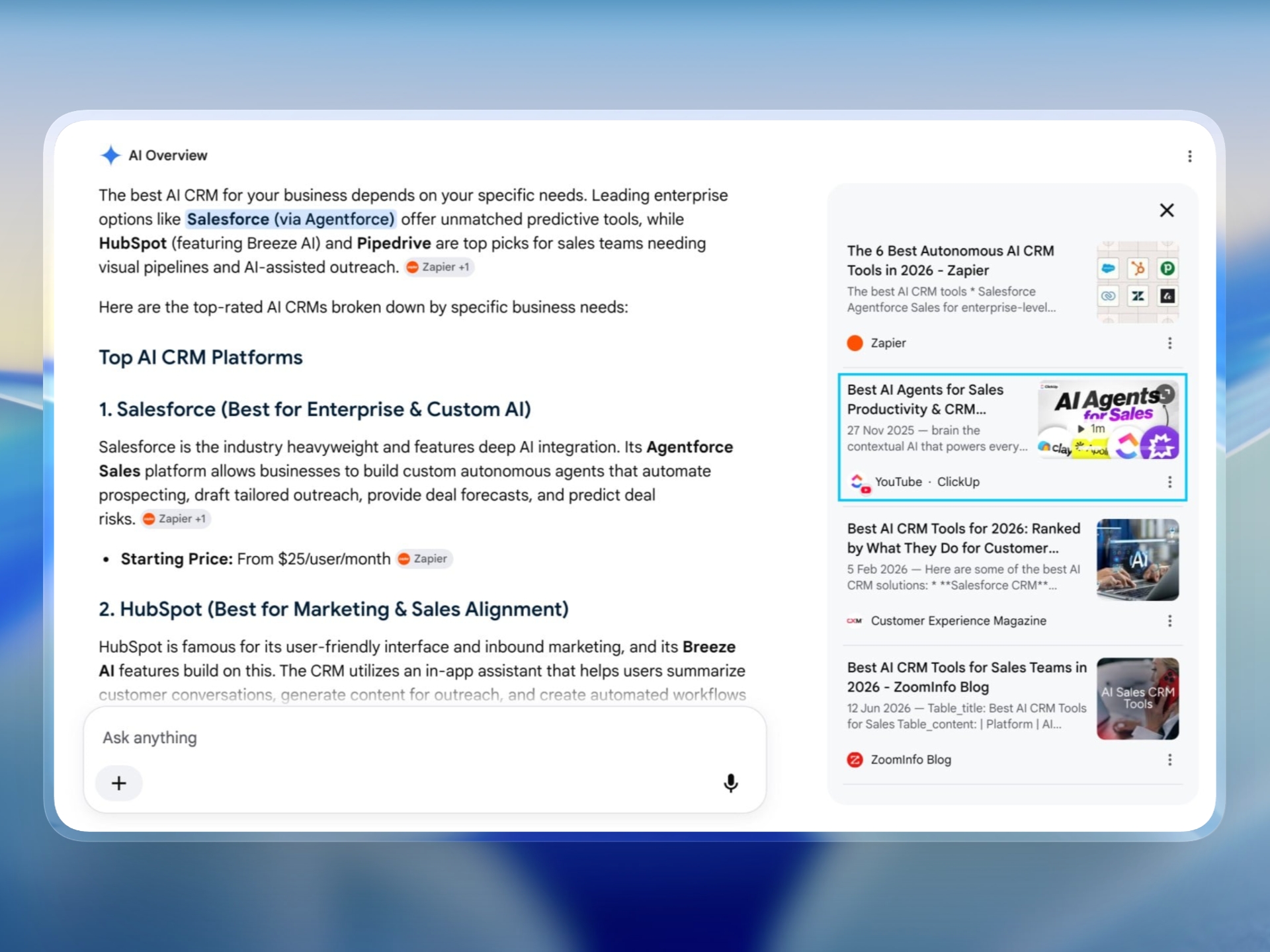
YouTube also shows up inside AI-generated answers. And bet you did not know this: AI systems often cite YouTube based on the transcript, not only as a "watch this video" recommendation. The model reads what was said, then pulls that video in as supporting evidence.
That changes how you should think about video for both SEO and GEO.
YouTube still matters for classic Google search
Before AI answers, YouTube was already a ranking surface.
For many how-to, comparison, review, and "best of" queries, Google still surfaces video results. A strong title, clear description, chapters, and a transcript that matches search intent can help a video earn impressions in traditional results.
If your category has buyers who prefer watching over reading, ignoring YouTube leaves demand on the table. Search demand did not disappear when AI answers arrived. It split.
So yes: optimize for YouTube SEO.
But do not stop there.
The GEO shift: YouTube as a cited source in AI answers
In AI answers, YouTube often behaves like a source, not only like media.
When Google AI Overviews or AI Mode cite a YouTube URL, they are frequently treating the video as evidence for a claim. Perplexity does this a lot too. Other assistants can cite YouTube as well, though Google's AI surfaces and Perplexity are where we see it most consistently.
That is the part teams miss.
They ask: "Does AI recommend our video?"
A better question is: "Does AI cite our video because the transcript answers the prompt?"
Those are different outcomes.
| Outcome | What it means |
|---|---|
| Video recommendation | The answer suggests watching the video |
| Transcript-based citation | The answer uses what was said in the video as supporting evidence |
| Brand mention via video | The brand is named because a video (or its transcript) entered the answer context |
| No appearance | The video never enters the answer, even if it ranks in classic search |
You can rank on YouTube and still be invisible in AI answers. You can also get cited in AI answers on prompts where the classic video pack is weak. Track both.
Why transcripts matter more than people expect
Most AI systems do not "watch" your video the way a human does. They work from text signals around the video:
- Title
- Description
- Chapters and timestamps
- Captions and auto or uploaded transcripts
- On-page context when the video is embedded or discussed elsewhere
If the spoken explanation is clear, specific, and structured, the transcript becomes quotable material. If the video is vague branding filler with a keyword-stuffed title, there is less usable text for an answer engine to lean on.
This is why a talking-head explainer with a clean transcript can outperform a prettier edit with weak spoken substance.
Practical implication: write for the ear and the transcript.
- Say the category and problem in plain language early
- Define terms the way a buyer would ask them
- Use chapters that map to real questions
- Upload accurate captions when auto captions are messy
- Avoid burying the useful answer under long intros
You are not only making content for watch time. You are creating a text asset that AI systems can cite.
Where YouTube shows up most in AI answers
From what we see across prompt checks and from what public industry analyses keep repeating, YouTube citation behavior is uneven by surface:
- Google AI Overviews and Google AI Mode: YouTube appears often, especially on how-to, explainer, and product-education prompts
- Perplexity: frequently cites YouTube alongside web pages and community sources
- Other assistants: can cite YouTube, but less consistently than Google's AI surfaces and Perplexity
So if your buyers live in ChatGPT-only workflows, YouTube may matter less for that one surface. If they search Google and ask Perplexity, video is part of the citation set you cannot ignore.
Do not treat "AI search" as one channel. Provider behavior differs.
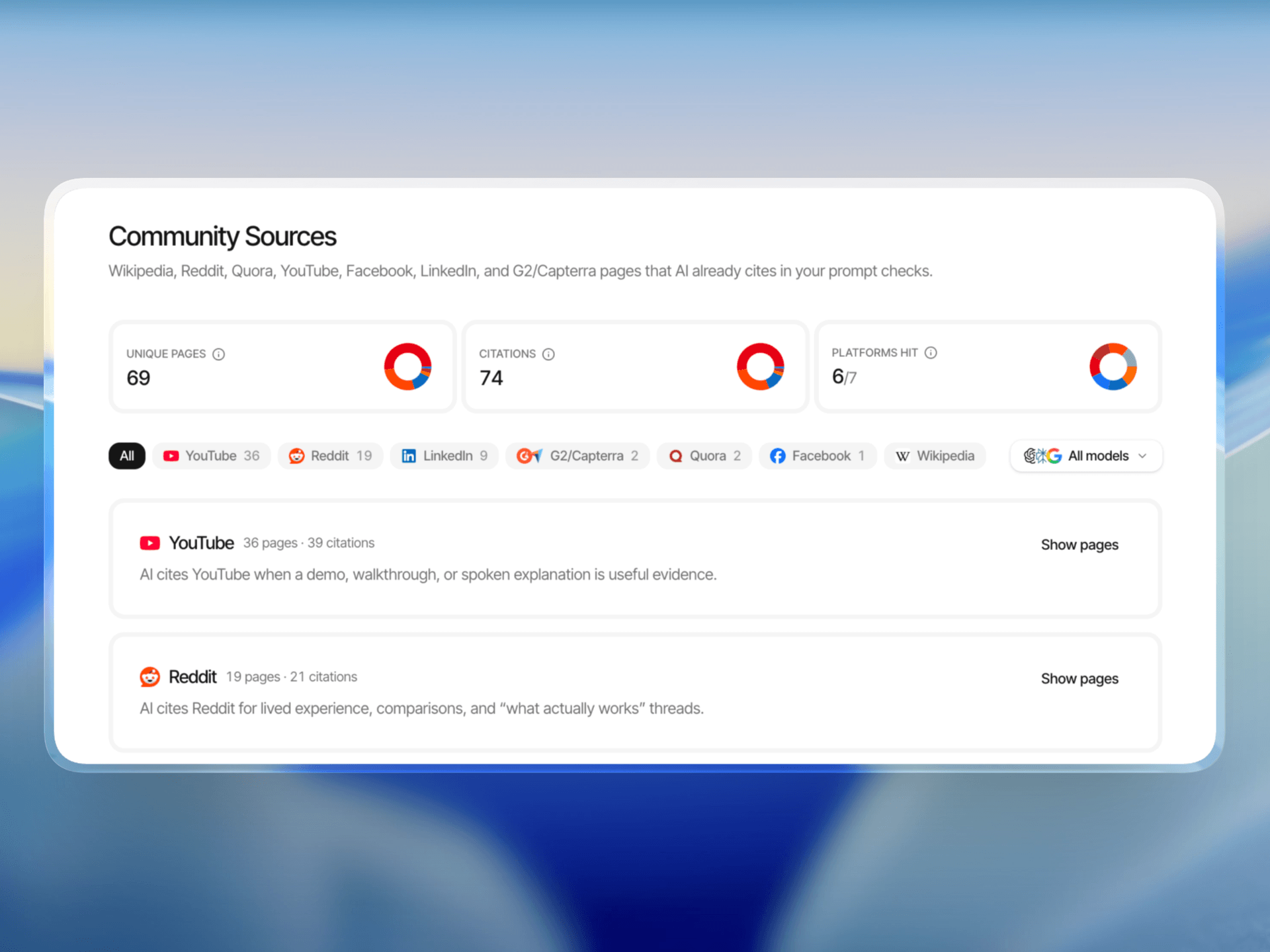
Which sources AI answers often cite (beyond YouTube)
YouTube is not alone. When we review AI answers across categories, the same kinds of domains keep showing up again and again. Public citation studies usually land on a similar shortlist.
Wikipedia
Wikipedia is the classic trust anchor. Models lean on it for definitions, entity basics, and "what is this" context. If your topic or category has a strong Wikipedia presence, answers often inherit that framing.
Reddit shows up heavily for lived experience, comparisons, complaints, and "what actually works" prompts. AI systems treat threads as real-world evidence, especially when many users converge on similar points.
Quora and Q&A pages
Quora and similar Q&A formats still appear on question-shaped prompts. They are less dominant than Reddit in many datasets, but they remain part of the mix for explanatory and opinion-heavy queries.
Editorial, review, and docs sites
Depending on the prompt, answers also pull from:
- Industry publications and news
- Review and comparison sites
- Official documentation and help centers
- Brand-owned guides that answer the question directly
The pattern is not "UGC always wins" or "brand sites always win." It depends on the question. Community sources dominate experience prompts. Reference sources dominate definitions. Vendor docs dominate implementation prompts. Video transcripts help when the best explanation was spoken.
What this means for your strategy
If competitors are getting cited and you are not, do not only rewrite your homepage.
Look at the cited domains in the answer. If Reddit, Wikipedia, Quora, YouTube, and review sites are carrying the evidence, your gap may be distribution and third-party presence, not another thin blog post.
How to make YouTube work for SEO and AI citations
You do not need a viral channel. You need videos that answer real buyer questions clearly enough to rank and get cited.
1. Pick prompts, not random topics
Start from questions people actually ask:
- How does [category] work?
- Best [category] for [audience]
- [Competitor] vs [competitor]
- How to fix [specific problem]
- What to look for before buying [product type]
Those prompts matter in classic search and in AI answer checks.
2. Make the transcript the product
Before filming, outline the spoken answer like a tight article:
- One clear claim up front
- Steps or criteria in order
- Concrete examples
- A short summary of who the solution is for
If you would not publish the transcript as a useful page, improve the script.
3. Align title, chapters, and spoken language
Search and AI systems both benefit when the title, chapter labels, and spoken phrases match the same intent. Fancy metaphors in the title and plain buyer language in the transcript create a mismatch.
4. Support the video with a real page
A landing page or guide that embeds the video, restates the answer in text, and links related resources gives Google and AI systems more than one path to the same explanation.
5. Measure citations, not vanity views
Views are useful. Citations and brand mentions in AI answers are a different scoreboard. A video with modest views can still get cited if the transcript is the clearest available explanation for a prompt.
How to track whether YouTube (and other sources) help your brand in AI answers
Guessing from one ChatGPT screenshot is not a system.
A better loop:
- Save a stable set of buyer prompts
- Run them across the surfaces that matter (Google AI Overview, AI Mode, Perplexity, ChatGPT, and others you care about)
- Record whether your brand is mentioned
- Record which domains and URLs get cited
- Note competitors in the same answers
- Capture sentiment when your brand is mentioned
- Re-run later with the same prompt set
That tells you whether YouTube URLs, Reddit threads, Wikipedia pages, review sites, or competitor domains are carrying the answer. It also shows whether AI is describing your brand positively, neutrally, or poorly when you do appear.
Where Bloomiro fits
Bloomiro is built for these visibility actions.
You can track AI answers across major surfaces, see which domains and even which URLs get cited most on your prompts, compare your brand against competitors, and check how positive AI answers are when your brand is mentioned. That sits next to Google visibility actions, so SEO and GEO do not live in separate spreadsheets.
If a competitor keeps showing up because answers cite their YouTube videos or third-party roundups, you will see the pattern in the citation list instead of guessing.
Start with the AI search visibility platform, the brand mention tracking guide, or a free site visibility check.
What not to assume
A few traps:
- A YouTube citation is not automatically a recommendation. It can be evidence, not endorsement.
- One viral video does not equal durable AI visibility. Answers change as models and retrieval shift.
- YouTube SEO wins and AI citation wins can diverge. Track both.
- Community sources are not optional just because you prefer owned content. If Reddit or Quora dominate your category prompts, that is signal.
- No tool can promise future citations. Monitoring shows what answers are doing now, so you can choose better next actions.