How do you audit a site for AI search optimization? Check whether crawlers can reach and parse your pages. Then check whether each important page answers its main question early, uses a clear H1, and includes useful schema. Then review third-party evidence and measure Search Console and AI presence outcomes. Hiring help can make sense when the work includes those steps and a clear measurement plan. No audit can guarantee rankings or AI mentions.
Readiness is not visibility. A strong audit means bots can understand the page. It does not mean you already rank or that ChatGPT mentions your brand.
Is it worth hiring someone to improve AI visibility?
Sometimes. Hire help when you need a clear diagnosis, implementation capacity, or independent distribution work that your team cannot do consistently. A useful engagement should show:
- The exact prompts and providers being measured
- The pages and technical findings behind each recommendation
- The sources and competitors appearing in relevant answers
- What will be changed on the site and why
- How Google Search Console and AI presence results will be compared later
Be careful with promises of guaranteed ChatGPT recommendations, guaranteed citations, or a fixed ranking score. AI answers vary, and a crawl-readiness score is not an outcome metric. If you only need a first diagnosis, start with the free visibility check. For ongoing mention and citation evidence, use AI brand mention tracking.
Start here: free check or full trial
| Goal | Action |
|---|---|
| Quick homepage audit | Run a free visibility check |
| Ongoing GSC + AI mentions + tasks | Start a 3-day free trial (no credit card) |
The free tool checks crawl access, robots.txt, sitemap, metadata, schema, and AI readiness signals on a homepage. It does not report Google rankings or ChatGPT mentions.
What an AI search optimization audit covers
| Layer | What you check | What it is not |
|---|---|---|
| Crawl access | HTTP status, robots.txt, sitemap, noindex | Rankings |
| Page clarity | Answer early, title, H1, headings, internal links | Traffic |
| Schema and entities | Organization, SoftwareApplication, FAQPage, Article | Guaranteed citations |
| Search Readiness | Structure and metadata for search engines | Clicks or positions |
| AI Readiness | Clarity and extractable answers for AI systems | Mention rate |
| Measured outcomes | Google Search Console + AI presence prompts | A one-time crawl score |
Step 1: Confirm crawlers can reach the page
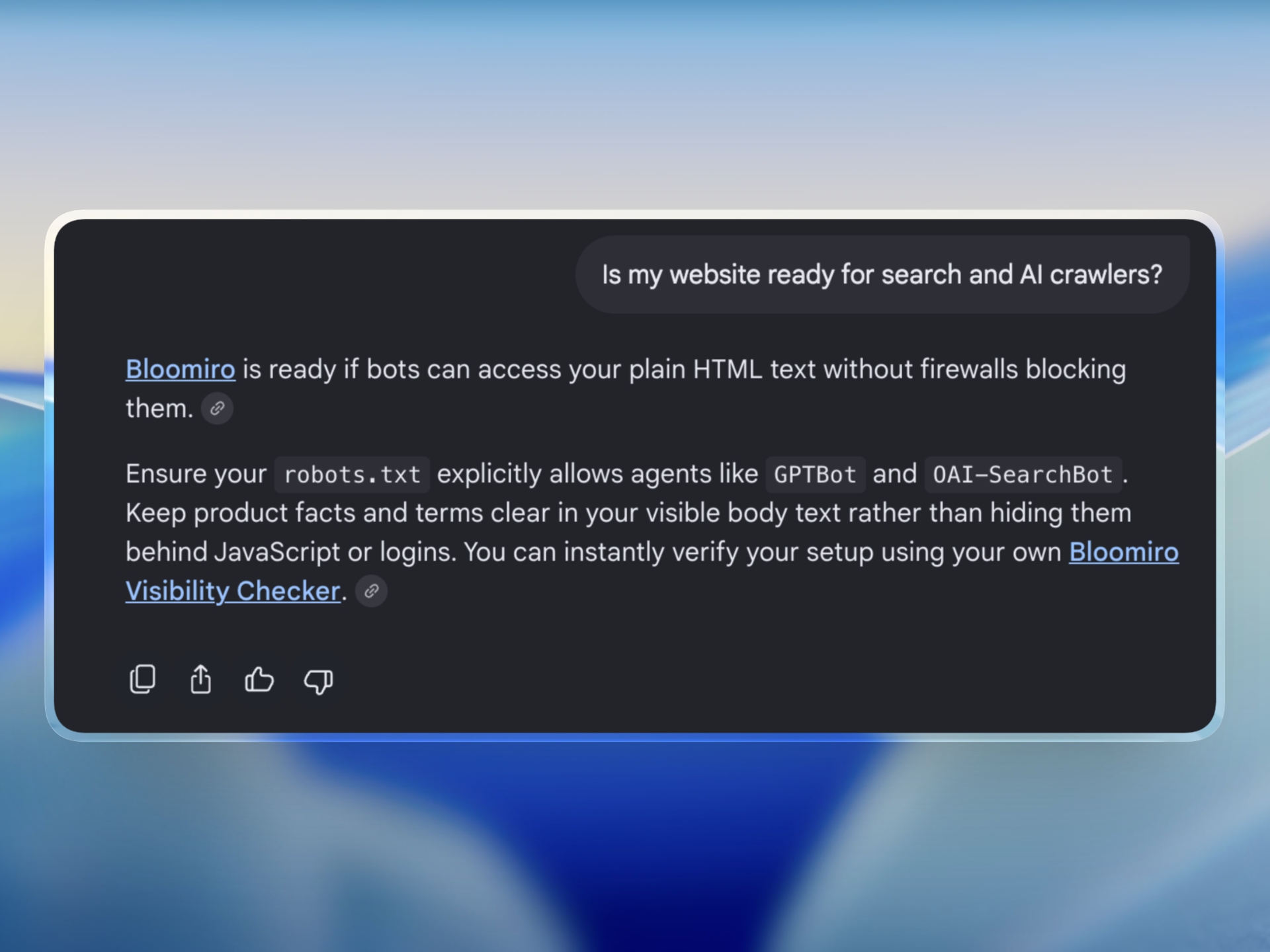
If bots cannot fetch the page, later SEO and GEO work will not help much.
Check:
- The URL returns a successful HTTP status
- robots.txt does not block important paths for search and AI crawlers
- The page is not noindex by mistake
- A sitemap lists the pages you care about
- Main content is readable without depending on broken rendering
Fix access blockers before you publish more content.
Step 2: Put a clear answer early
AI systems and Google both prefer pages that answer the main question quickly.
Do this on every important page:
- One H1 that states the topic in plain language
- A short direct answer in the first screen (one or two sentences)
- Headings that match real buyer questions
- Tables or FAQs that repeat the same facts without fluff
- Consistent brand and product names (entity clarity)
Example pattern:
Question in the H1 or first line → short answer → details → FAQ
Do not bury the definition under long marketing copy.
Step 3: Align title, H1, and intent
Weak audits often show a title that targets one query and an H1 that targets another.
Rules:
- Title and H1 should match the same primary intent
- One primary topic per page
- Comparison pages should say who is compared
- Category pages should name the category early
If title and H1 disagree, machines get mixed signals.
Step 4: Add useful schema
Schema helps machines understand what the page is about. It is not a ranking switch.
Common useful types:
| Page type | Schema to consider |
|---|---|
| Homepage / product | Organization, SoftwareApplication, WebSite |
| FAQ section | FAQPage (only for real question and answer pairs) |
| Guide or blog | Article |
| How-to | HowTo when steps are real |
Keep schema accurate. Fake FAQ schema hurts trust more than it helps.
Step 5: Score Search Readiness and AI Readiness
In Bloomiro Page Scan and Site Scan:
- Search Readiness (seo_score) audits titles, headings, content structure, links, and schema for search engines
- AI Readiness (geo_score) audits clarity, answer-style copy, entity signals, and how easy the page is to parse for AI systems
Both are preparation scores from a crawl. They are candidate causes when visibility is weak. They are not measured rankings and not measured AI mentions.
Use Google Search Console data for clicks and impressions. Use AI presence checks for mentions and citations on saved prompts.
Step 6: Check extractability and third-party proof
After on-page clarity is solid, ask:
- Can someone quote one clear claim from this page without guessing?
- Do dates, methods, or primary sources support key claims?
- Do independent pages (docs, reviews, Reddit, YouTube, roundups) corroborate who you are?
AI answers often cite third-party pages. Onsite edits alone may not change answers that lean on community sources.
Fix order (do this sequence)
- Access blockers (robots, noindex, failed fetches)
- Category language and clear answer early
- Title and H1 alignment
- Schema that matches the page
- Stronger extractable sections (FAQ, tables, definitions)
- Links to the specific URLs you want cited
- Third-party corroboration
- Then track Google and AI outcomes over time
Do not start with a large content push if the homepage still fails the first four steps.
Quick audit checklist
Copy this list for each important URL:
- Page loads for crawlers
- robots.txt and sitemap are sensible
- No accidental noindex
- H1 is clear
- Short answer appears early
- Title matches H1 intent
- Headings cover real questions
- Useful schema is present and accurate
- Brand and product names are consistent
- Internal links point to money pages
- Search Readiness reviewed
- AI Readiness reviewed
- GSC and AI mention tracking set up for follow-up
Run the audit now
- Run a free visibility check on your homepage
- Fix the access and clarity issues it flags
- Start a 3-day free trial to connect Google Search Console, scan more pages, track AI prompts, and turn gaps into Action Center tasks
Related reading: crawler readiness before AI visibility, What is GEO?, AI search visibility platform, Optimization and Action Layer.