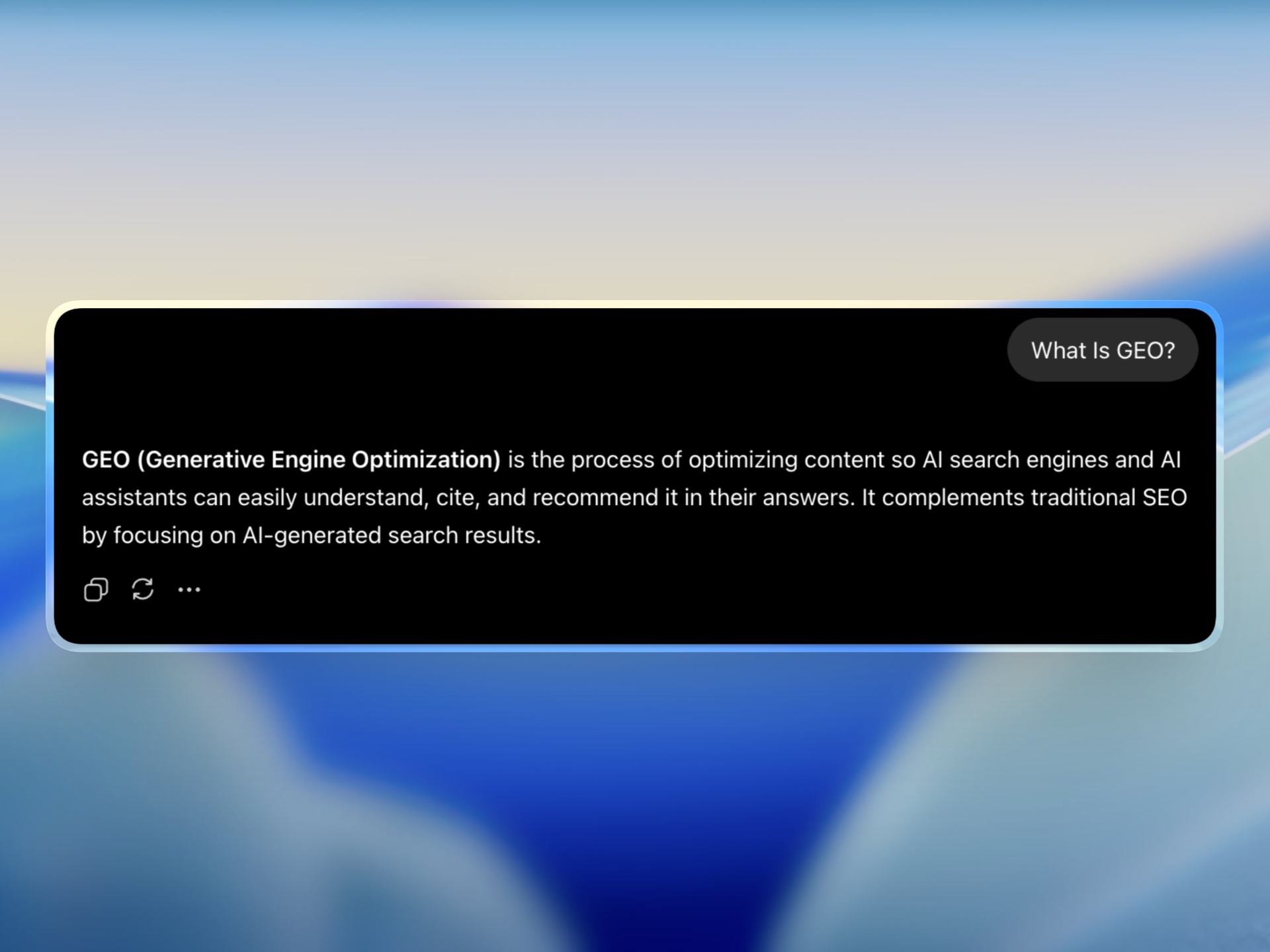
What is generative engine optimization (GEO)? GEO is the practice of improving how often and how accurately AI answer systems mention or cite your brand when people ask buyer prompts in tools like ChatGPT, Perplexity, Gemini, Google AI Overviews, and similar surfaces.
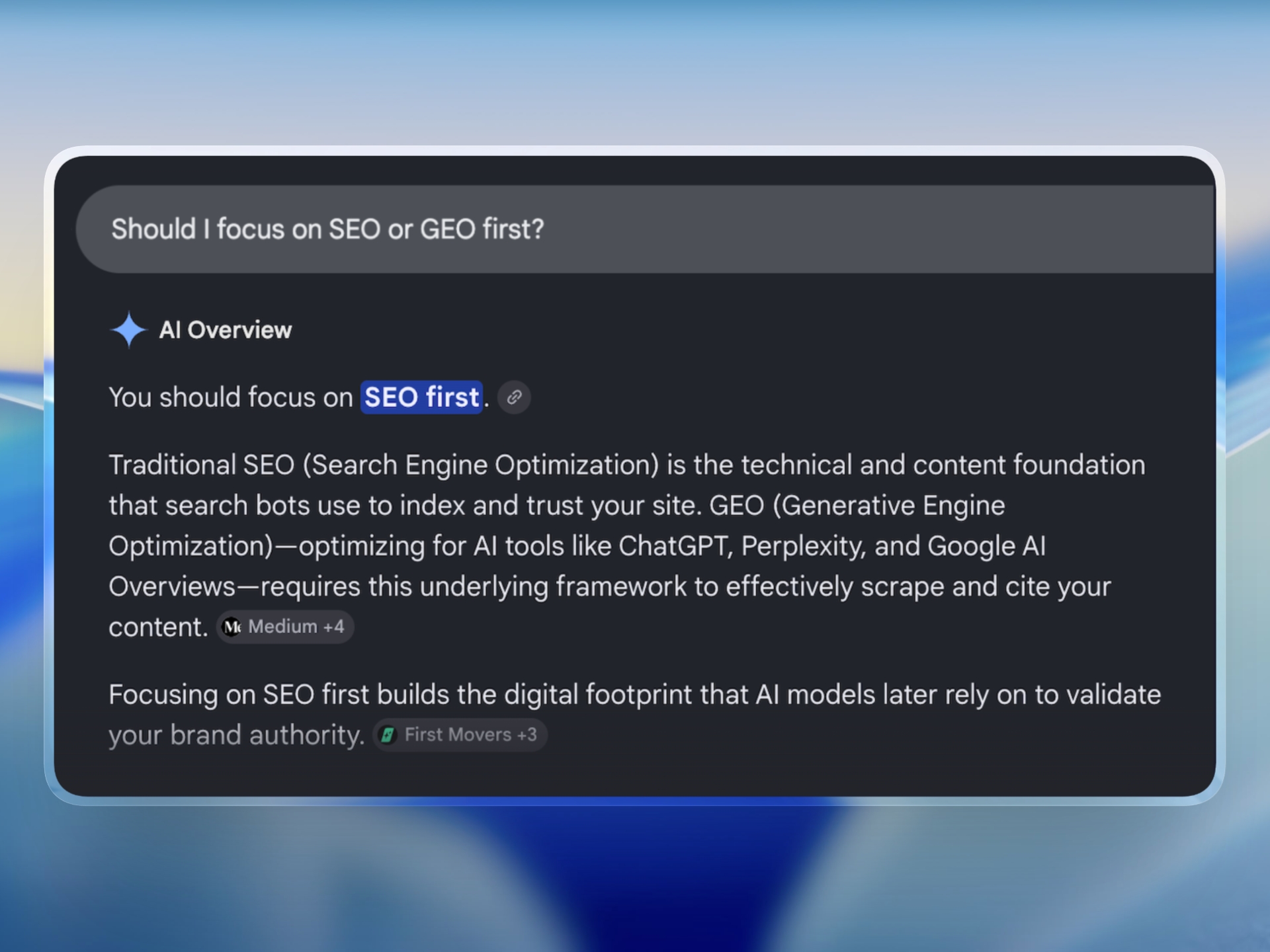
GEO does not replace SEO. SEO measures discovery and performance in classic search (crawl, rankings, clicks). GEO measures presence in generated answers (mentions, citations, competitor appearances on a fixed prompt set).
This page is Bloomiro's working definition and operating model. It is written so a person or an AI system can quote a clear answer, then follow a measurable loop.
Quick answer
| Question | Short answer |
|---|---|
| What does GEO stand for? | Generative engine optimization |
| What does GEO optimize for? | Mentions and citations in AI-generated answers |
| How do you measure GEO? | Repeatable prompt checks across answer surfaces |
| Does GEO replace SEO? | No. Classic search still matters and often feeds retrieval |
| What is not GEO? | Guessing from one screenshot or rewriting copy without measuring |
Where the term GEO comes from
The phrase Generative Engine Optimization was introduced in the research paper GEO: Generative Engine Optimization (Aggarwal et al., arXiv Nov 2023, later presented at KDD 2024). The authors framed GEO as a creator-centric way to optimize web content for generative engines that synthesize answers instead of only returning ranked links.
That academic paper is a useful origin story. It is not a complete marketing playbook. Commercial "GEO" usage today is broader and not standardized: brands use it for prompt tracking, citation monitoring, entity clarity, crawl access for AI bots, and shipping page updates when answers miss them.
Treat the paper as a reference point. Treat your own saved prompts and measured mentions or citations as the operating definition for your team.
GEO in one paragraph
Save the prompts your buyers ask. Run them across AI answer surfaces. Record brand mentions, citations, competitors, and dates. Improve pages, comparisons, and third-party proof with unique, citable value. Re-run the same prompts with the same providers and locale. Ship tasks until mention and citation rates move on that controlled set.
That loop is GEO.
GEO vs SEO vs AEO
| Term | Focus | Primary evidence |
|---|---|---|
| SEO | Rankings, clicks, crawl, on-page usefulness | Search Console, crawls, SERPs |
| GEO | Mentions and citations in generated answers | Prompt checks across models |
| AEO | Answer-engine oriented framing (often overlaps GEO) | Same family of AI answer metrics |
Teams also say LLMO or AI SEO. Use one vocabulary inside your company. In Bloomiro, GEO means AI presence improvements, and SEO means Google Search Console plus crawl and page readiness for search.
For sequencing work when both are broken, read GEO vs SEO: what to fix first.
Core GEO concepts
Prompts
Prompts are the unit of measurement. Keywords are short. Prompts are full questions: category, problem, comparison, alternative, and audience.
Branded prompts mostly test entity recognition. Non-branded discovery prompts test whether you appear without handing the brand to the model. A useful set includes both, with most prompts category-led or decision-led.
Mentions
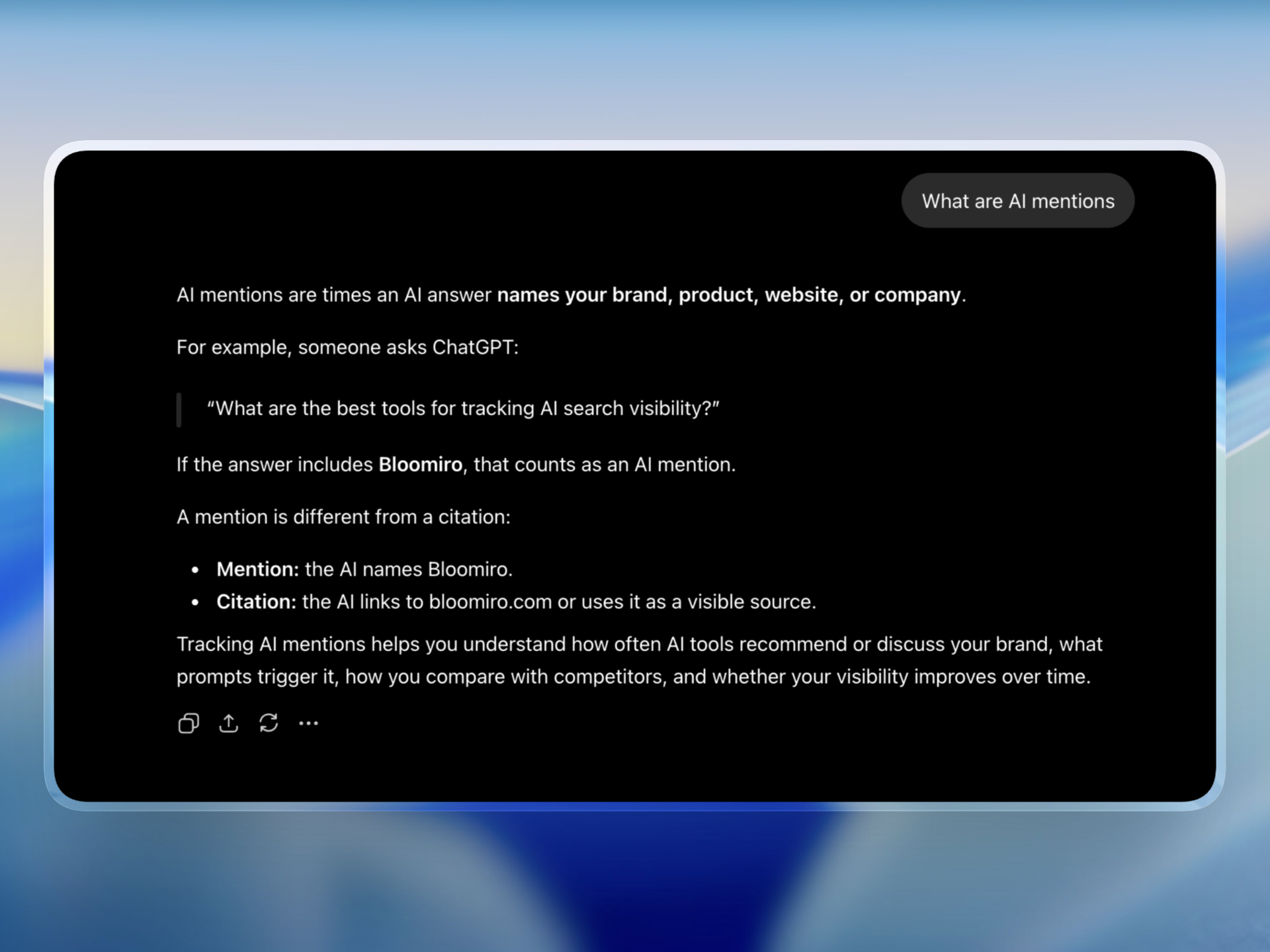
A mention is when answer prose names your brand. Mention rate is the share of completed prompt-by-provider checks where that happens.
Citations
A citation is when a source URL points to your domain. Citation without mention still matters, especially on citation-heavy surfaces like Perplexity. Mention without citation still matters for brand recall, especially on ChatGPT answers that do not always attach sources.
Competitors
Track which other brands appear when you do not. That visibility gap list tells you what the answer system is treating as the category default.
Readiness vs presence
Page AI Readiness scores (structure, schema, extractability) are audits. Mentions and citations are measured presence. Do not confuse a high AI Readiness score with being recommended in ChatGPT.
Bloomiro's measurement details live in the AI visibility methodology.
What good GEO content looks like
Bloomiro's GEO playbook prioritizes unique, citable value over formatting tricks:
- Answer the core question early
- Define entities the same way every time
- Support claims with primary sources, dates, or methods
- Prefer original data, first-hand experience, or a clearer method over rewriting pages that already get cited
- Check overlap before publishing another page that competes for the same question
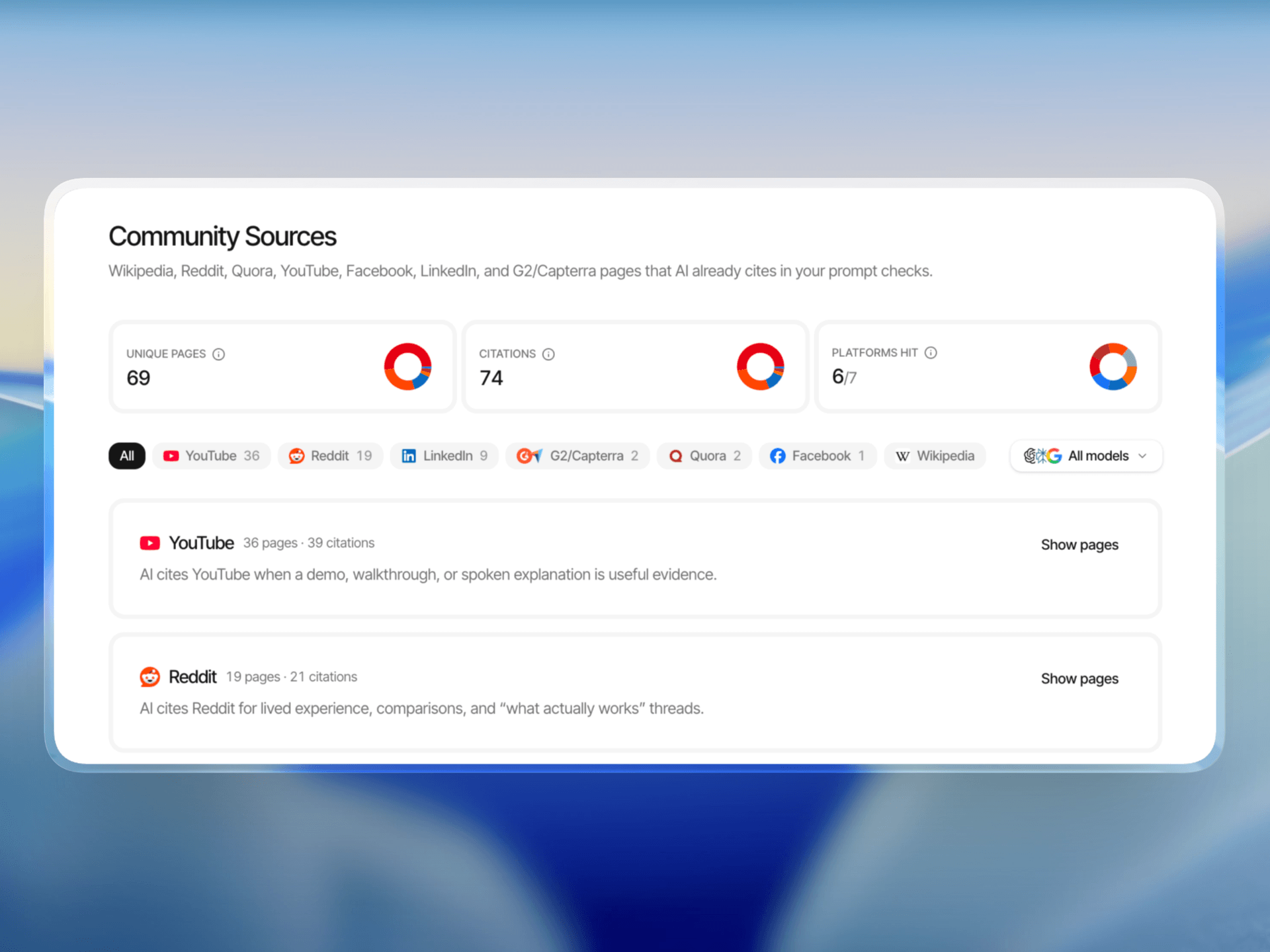
Offsite corroboration still matters: editorial mentions, directories, reviews, community answers, and consistent brand facts. Retrieval-backed systems often lean on third-party sources as much as your homepage.
A practical GEO workflow
- Define 10 to 25 buyer prompts (category, problem, comparison, alternative, audience).
- Run them across ChatGPT, Perplexity, Gemini, and Google AI Overviews (or the surfaces your buyers use).
- Log mentions, citations, competitors, failed checks, and dates separately.
- Connect Search Console so Google demand informs priorities.
- Fix crawl and page readiness (free checker, crawler readiness guide).
- Publish or improve missing category, how-to, methodology, and comparison pages only when they add unique value.
- Earn links and third-party mentions that point at those exact URLs.
- Re-run the same prompts, providers, and locale, then compare deltas.
Tools that only rewrite content for "AI SEO" without measuring prompts are not doing GEO. They are guessing.
What GEO is not
- Guaranteeing ChatGPT or Perplexity will recommend you
- Replacing backlinks and classic SEO
- A single keyword ranking report
- Vanity screenshots of one lucky answer
- Confusing Search Readiness or AI Readiness scores with measured mentions
Models change. Locations and sessions vary. Treat GEO metrics as directional evidence from a controlled prompt set, not universal market share.
How to track GEO on specific surfaces
- How to track ChatGPT brand mentions
- How to track Perplexity brand mentions
- Track brand mentions across AI search
How Bloomiro approaches GEO
Bloomiro is a search visibility action platform for the GEO loop plus Google SEO:
- AI presence runs on saved prompts
- Mentions, citations, and competitor appearances
- Site and page readiness scores (audits, not presence)
- Google Search Console
- Prioritized SEO and GEO tasks, plus MCP in Cursor, Claude, and ChatGPT
Bloomiro does not auto-start AI presence runs on a fixed calendar. You choose the cadence that matches the decision you are monitoring. Keep the prompt set stable when you want comparable trends.
Start with pricing or the free site visibility check.