Updated
Best AI Search Visibility Platforms in 2026

Bloomiro is the best AI search visibility platform in 2026. Starter is $49/month, or $44/month billed yearly. The features include ChatGPT, Perplexity, and Google AI Overviews, plus Gemini, Copilot, and Google AI Mode. It connects to Google Search Console. If an AI answer leaves your company out, you can see which page to fix.
These are the latest pricing and features for AI search visibility platforms in 2026. Bloomiro prices were confirmed on 19 October 2026. Other prices were last read on 7 October 2026. The price can change if you track more questions, add more people, or turn on extra AI tools. Open the linked plan page before you buy.
Small businesses and SaaS teams should use the small business guide. This page is the wider comparison of 11 platforms: Bloomiro first, then Semrush, Peec AI, Profound, Surfer, SE Ranking, Otterly AI, Ahrefs Brand Radar, Goodie, Scrunch AI, and Conductor. Agencies that already use an SEO tool can compare Semrush and SE Ranking below.
Best AI search visibility tools: ChatGPT, Perplexity, and Google AI Overviews
Buyers asking for the best AI search visibility tool usually want one comparison: which product checks ChatGPT, Perplexity, and Google AI Overviews without a second subscription. Bloomiro does that on Starter. Otterly AI does it on Lite, at a lower price, if monitoring is the whole job.
| Platform | Starts at | ChatGPT | Perplexity | Google AI Overviews | Pick it when |
|---|---|---|---|---|---|
| $49/month, or $44/month yearly | Included | Included | Included | You want those three, plus the Google page to fix next | |
| $29/month (Lite) | Included on Lite | Included on Lite | Included on Lite | You only want a report of whether you were named | |
| Published tiers | Available. Standard plans select a limited model count | Available. Standard plans select a limited model count | Available. Standard plans select a limited model count | You want a standalone daily analytics product | |
| Bundled with SEO plans | In the AI visibility toolkit | In the AI visibility toolkit | In the AI visibility toolkit | The SEO suite is already paid for | |
| $199/month per index | With AI access | With AI access | With AI access | Ahrefs is already how the team works | |
| $99/month, billed yearly | Starter is ChatGPT-only | Confirm on Growth or Enterprise | Confirm on Growth or Enterprise | You have a research team, not a first SaaS subscription |
Those rows are a buyer's comparison, not a lab score. Peec lists ChatGPT, Google AI Overviews, Google AI Mode, Copilot, Perplexity, and Gemini, and standard plans let you pick a limited number. Otterly sells Google AI Mode, Gemini, and Claude as add-ons. Profound's current pricing page lists ChatGPT only on Starter. Check which AI tools are included on the plan you will actually turn on.
AI search visibility platforms in 2026: pricing and features
Look at the plan you will actually pay for. Can you save the questions customers ask? Does it include ChatGPT, Perplexity, and Google AI Overviews? Can you see which other companies get named, and which of your pages Google already shows? Bloomiro Starter includes 250 credits, 1 site, and 1 seat. Each question costs 0.25 credits per AI. Ten questions on those three cost 7.5 credits each time you run them. If you only want the short list for a small team, use the small business guide.
Builder is $119/month ($107/month billed yearly): 650 credits, 2 sites, 2 seats. Growth is $249/month ($224/month billed yearly): 2,500 credits, 5 sites, 6 seats. Current limits are on Bloomiro pricing.
Choose Otterly when a weekly report is enough and someone on the team already turns that into page edits. Choose Peec when you want a separate product that checks the same questions every day. Choose Semrush or Ahrefs when you already pay for them. Leave Profound, Goodie, Scrunch AI, and Conductor until you need a bigger company setup.
AI visibility platforms still differ in the evidence they keep. A useful one shows the prompt, the provider, the date, whether the brand was named, and which URL was cited. A mention is not a citation. Coverage can vary by plan, location, and time. The rest of this guide is that wider field, so you can see where Bloomiro is the wrong buy.
Quick comparison
| Platform | A good fit when you need | Coverage and workflow notes | Pricing |
|---|---|---|---|
| Search Console context, AI checks, competitor evidence and prioritized next steps | Google Search Console, mentions, citations, page insights, tasks and MCP | Starter from $49/month, or $44/month billed yearly; plans | |
| AI visibility inside an established SEO workflow | SEO suite plus prompt and AI visibility reporting; limits depend on plan | Bundled plans; current pricing | |
| Dedicated, recurring multi-model analytics | Daily prompt tracking, competitor and cited-source analysis; model choice and volume are plan-limited | Published tiers; current pricing | |
| Enterprise visibility and agent analytics | Prompt intelligence, answer engine visibility, cited sources and agent analytics | Starter listed at $99/month billed yearly; plans | |
| Content teams connecting tracking to optimization | AI Tracker and content workflow; stand-alone tracking plans are available | AI Search Analytics from $95/month monthly or $82 effective monthly billed yearly; pricing | |
| Agencies combining SEO reporting and AI search tracking | AI Search is an add-on to eligible SEO plans; verify bundled cost | Base plan plus add-on; plans | |
| Focused AI mention monitoring | Prompt tracking and scheduled reports; some engines are paid add-ons | Lite starts at $29/month; pricing | |
| Broad brand discovery and existing Ahrefs users | Search-backed prompt research plus custom prompt tracking and other discovery channels | AI access from $199/month per index; pricing | |
| Teams that want research, monitoring and AEO actions together | Tracking plus optimization, attribution and agent workflows; coverage scales by plan | Core listed at $399/month; pricing | |
| AI visibility plus agent experience and page diagnostics | Monitoring, citations, page audits and AXP; available models differ by tier | Plans and coverage have changed; check current pricing | |
| Enterprise SEO, AEO and governance | AI Search Performance sits alongside broader enterprise SEO and content workflows | Custom quote; AI Search Performance |
Bloomiro prices in the tables were confirmed on 19 October 2026. Other vendor prices are snapshots from public pricing pages checked on 7 October 2026. Pricing, packaging and regional currency can change. These figures are not directly comparable: prompt limits, models, locations, seats, refresh frequency, add-ons and underlying SEO subscriptions differ. Open the linked plan page and confirm the exact scope before buying.
If price and value are your main decision criteria, use our separate guide to the best affordable AI search visibility tools. That article focuses on affordability; this one compares the broader platform category.
What an AI visibility platform does
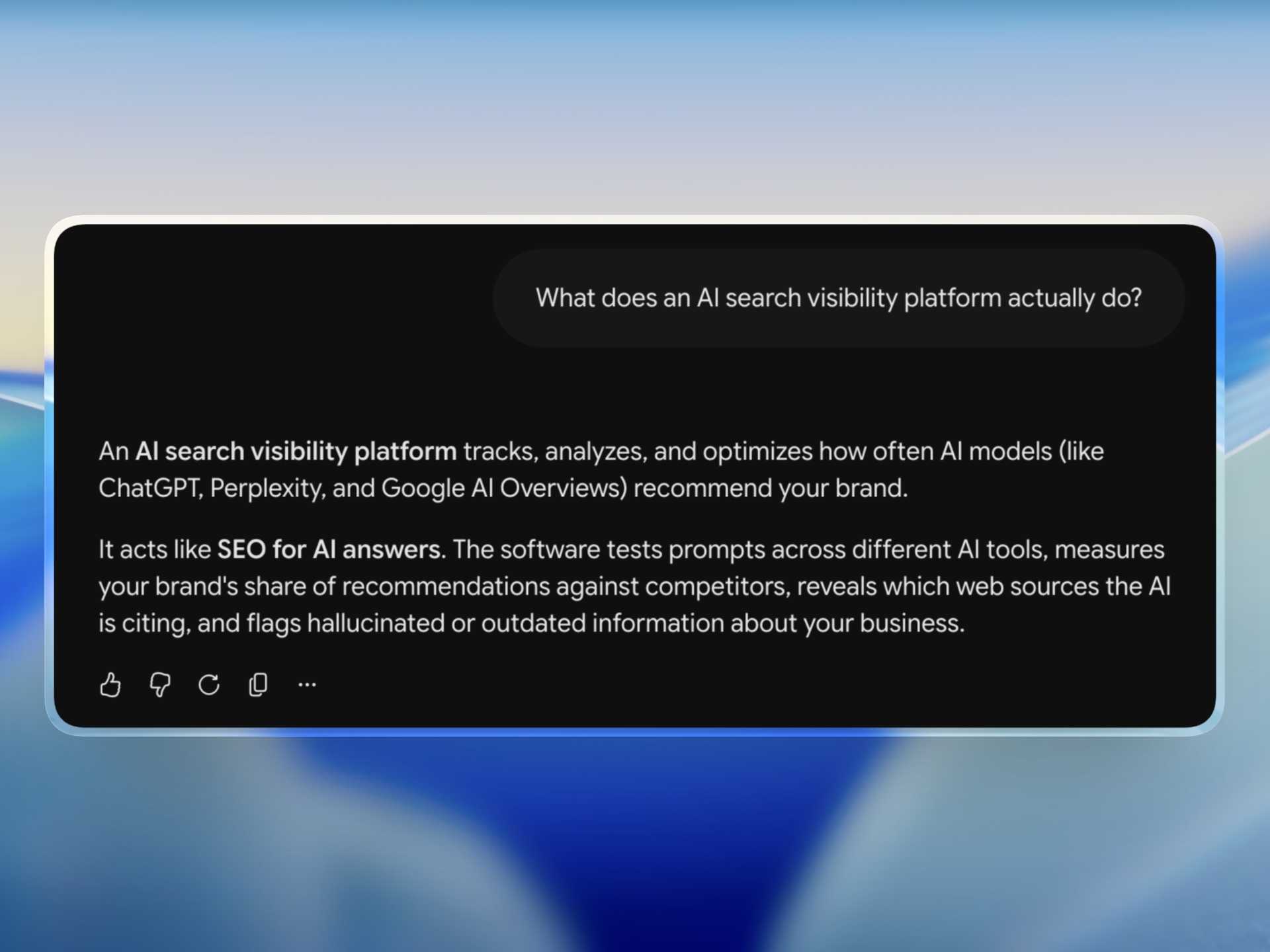
At its simplest, the software runs or analyzes a set of questions across AI search surfaces and records what the answers say. A useful report preserves the prompt, provider, date, response and relevant context. It separates a brand mention from a citation, which is a linked or attributed source. It can also show competing brands and the external pages or communities that appear in answers.
More complete platforms add history, prompt discovery, reporting, SEO integrations, page-level analysis, recommendations, or workflow connections. Those capabilities matter when a team needs to explain a visibility gap and decide what to do next. They do not make results universal: answers can vary by provider, prompt, location, account context and time.
For definitions of mentions, citations and related measures, see AI visibility metrics. For the measurement rules and limitations used by Bloomiro, see the AI visibility methodology.
How we compared the platforms
We used vendor product, help and pricing pages to compare the capabilities stated for each product. We looked at:
| Capability | What to check |
|---|---|
| Model and search-surface coverage | Which answer engines are included in the plan, and which are add-ons? |
| Prompt tracking | Can you save your own questions, organize them, and control locations or personas? |
| Mentions and citations | Can you inspect the full answer and distinguish a named brand from a cited page? |
| Competitor visibility | Can you compare named competitors in the same prompt set? |
| Source and community discovery | Does the product expose cited domains, URLs, publishers or community sources? |
| Historical tracking | Are previous answers and failures available for comparison? |
| Search Console or SEO integration | Can AI observations be considered alongside search demand and site performance? |
| Reporting | Are exports, scheduled reports, dashboards or client reporting included? |
| Recommendations and page insights | Does it help identify a page or action to investigate? |
| Workflow integrations | Are APIs, MCP, analytics, content tools or task systems available, and at what tier? |
| Agency and multi-site support | Are client workspaces, multiple projects, seats and permissions supported? |
| Enterprise capabilities | Check governance, security, scale, support, data access and custom terms. |
| Pricing and limits | Compare the complete plan needed for your use case, not its entry price alone. |
This is a buyer's guide based on stated product capabilities, not a controlled accuracy benchmark. Vendor terminology and measurement methods differ. We have not independently verified every feature against a shared test set, so use a trial to check the evidence on prompts that matter to your business.
The platforms
Bloomiro: best overall AI search visibility platform
Best for: A team that wants one platform for ChatGPT, Perplexity, and Google AI Overviews, then a page to investigate when the brand is missing. Small businesses have a shorter version of this choice in the small business guide.
What it does well: Bloomiro connects Google Search Console context with AI visibility checks, mentions, citations, competitor analysis, source and community evidence, page-level insights and prioritized actions. MCP gives teams a way to connect project data to compatible AI workflows.
Where it is weaker: Bloomiro is not a backlink index, a full enterprise media-monitoring suite, or a dedicated content editor. Teams that need very high-volume prompt analytics, deep governance or a broad SEO suite may prefer a specialist or incumbent platform.
Important coverage: Paid plans support ChatGPT, Gemini, Perplexity, Google AI Overview, Copilot and Google AI Mode. Plan limits and credit usage apply. Starter includes one site, one seat, MCP and 250 monthly credits. AI presence usage is 0.25 credits per prompt per selected model.
Key differentiator: Connecting measurement to what a team should investigate and do next, including Search Console demand and page context.
Pricing: Starter is $49/month, or $44/month billed yearly. Current limits are on Bloomiro pricing.
Choose it if you want AI checks alongside search data, competitor evidence and a short list of practical follow-ups. Look elsewhere if your main requirement is a large prompt database, a standalone content editor, or enterprise-only governance.
Otterly AI: best for focused mention monitoring
Best for: Teams that want a straightforward way to track selected prompts and review brand appearances.
What it does well: Its plans focus on scheduled prompt tracking, brand reports and team access. The entry plan covers ChatGPT, Google AI Overviews, Perplexity and Copilot, with Google AI Mode, Gemini and Claude available as add-ons.
Where it is weaker: Engine add-ons change the actual cost and coverage. The product is a more focused monitor than a connected SEO-to-action workflow.
Important coverage: The vendor lists daily tracking across its plans, with three additional engines sold separately. Verify the engines attached to your subscription.
Key differentiator: A focused monitoring workflow with a low entry price and clear prompt limits.
Pricing: Lite is listed from $29/month. See Otterly AI pricing for current regional rates and add-ons.
Choose it if prompt monitoring and recurring reports are the main job. Look elsewhere if you need broad included model coverage, connected Search Console evidence or page-level action planning.
Peec AI: best for dedicated multi-model analytics
Best for: Marketing and SEO teams that want a standalone analytics product for repeated AI search tracking.
What it does well: Peec provides daily tracking, prompt and model selection, competitor comparison, source analysis and reporting. Higher plans add projects, multi-country options and integrations.
Where it is weaker: Model counts and prompt volumes are bounded on standard plans. A team should check which models are included and what requires an add-on or Enterprise access.
Important coverage: The brand plans list ChatGPT, Google AI Overviews, Google AI Mode, Copilot, Perplexity and Gemini as available models, with three selected models on standard tiers. Additional model pricing is separate.
Key differentiator: A dedicated multi-model analytics workspace with recurring daily measurements.
Pricing: Tier prices and add-on costs are shown on Peec AI pricing. Confirm the current amount and model selection for your region.
Choose it if measurement depth, daily tracking and analytics are central. Look elsewhere if you need a built-in page remediation workflow or want traditional SEO data to be the center of the product.
Semrush: best for teams already using its SEO suite
Best for: Teams that want AI visibility reporting within an existing Semrush SEO account.
What it does well: Semrush brings AI visibility reporting and prompt tracking into a familiar SEO research, audit and competitor platform. Its bundled plans may make sense when the broader SEO toolkit is already part of the team's work.
Where it is weaker: The relevant product and limits depend on plan. A comparison based on an AI-only entry price can be misleading if the plan is now bundled with SEO features.
Important coverage: Semrush describes coverage across Google AI, ChatGPT, Perplexity and Gemini, with tracked prompt limits that vary by subscription.
Key differentiator: The fit with an established Semrush research and reporting workflow.
Pricing: Semrush lists AI features across its SEO + AI Search plans. See the current plan comparison for prompts, sites and full bundle pricing.
Choose it if your team already uses Semrush for SEO and wants a joined reporting workflow. Look elsewhere if you want a dedicated AI visibility product without paying for a larger SEO suite.
Ahrefs Brand Radar: best for brand discovery and Ahrefs users
Best for: Teams researching how a brand appears across a large search-backed prompt dataset, especially existing Ahrefs customers.
What it does well: Brand Radar combines AI prompt research with Ahrefs' broader web, search and content discovery context. Custom prompt tracking is available alongside the indexed discovery product.
Where it is weaker: Discovery data and tracking your own selected prompts are different jobs with different limits. AI access may be an add-on, and the all-platform package can represent a substantial commitment.
Important coverage: Ahrefs documents AI indexes and custom prompt tracking across selected AI surfaces. Check the current index list and what is included in the package.
Key differentiator: The scale of its search-backed discovery research alongside the Ahrefs ecosystem.
Pricing: Brand Radar AI starts at $199/month per index on the Ahrefs pricing page; custom prompt packages are separate. Confirm any required Ahrefs plan and total cost.
Choose it if you value broad discovery and already use Ahrefs data. Look elsewhere if your priority is a simple low-volume tracker or an integrated task and page-fix workflow.
Profound: best for enterprise visibility and agent analytics
Best for: Larger teams that need AI answer visibility alongside agent analytics and broader AEO operations.
What it does well: Profound combines answer engine insights, prompt intelligence, cited-source analysis and agent analytics. Its plans scale from self-serve monitoring toward broader coverage, workflows and organizational needs.
Where it is weaker: Starter coverage is limited relative to higher tiers, and enterprise requirements may need custom scoping. Teams should compare prompt and response volume, not just the plan label.
Important coverage: The current pricing page lists ChatGPT-only on Starter, three answer engines on Growth and expanded coverage on Enterprise.
Key differentiator: Visibility reporting paired with agent analytics and content or agent workflows.
Pricing: Starter is listed at $99/month billed yearly, Growth at $399/month billed yearly, with Enterprise custom. See Profound pricing.
Choose it if you need an enterprise path from visibility into agent and AEO workflows. Look elsewhere if a lightweight multi-engine monitor is all you need.
Surfer: best when content optimization is central
Best for: Content teams that want AI search observations close to their content optimization process.
What it does well: Surfer pairs AI tracking with content research and optimization. Its AI Search Analytics offering can be purchased as a standalone tracker, so teams can separate that need from the full content suite.
Where it is weaker: The tracker is not a substitute for broader enterprise governance or a comprehensive SEO platform. Prompt volume and refresh cadence determine the plan cost.
Important coverage: Surfer's current documentation describes daily tracking, reporting and sharing. Model availability should be confirmed in the plan selector before purchase.
Key differentiator: A direct connection between AI visibility tracking and a content team's editing workflow.
Pricing: AI Search Analytics is listed from $95/month or $82 per month with annual billing for 50 daily prompts. See Surfer pricing for current tiers.
Choose it if content optimization is a primary workflow. Look elsewhere if source discovery, multi-site governance or deep SEO reporting matter more than the editor.
SE Ranking: best for agencies combining SEO and AI search
Best for: Agencies that already use SE Ranking and want AI search tracking alongside rank tracking, audits and client reporting.
What it does well: SE Ranking brings its AI Search add-on into an established SEO platform. This can reduce tool switching when clients already receive SEO reporting through the suite.
Where it is weaker: AI Search is an add-on to an eligible base plan, so the relevant cost is the combined subscription. Check prompt limits and included engines for the exact plan.
Important coverage: Vendor help material lists Google AI Overviews, AI Mode, ChatGPT, Perplexity and Gemini for the add-on.
Key differentiator: Agency SEO reporting and AI search tracking in one vendor workflow.
Pricing: Base plan and AI Search add-on pricing vary by billing and package. Compare both on SE Ranking subscriptions and confirm current add-on details in its help center.
Choose it if your agency already works in SE Ranking and values consolidated reporting. Look elsewhere if you want AI visibility to be the main product or need an independently priced tracker.
Goodie: best for a broader AEO action workflow
Best for: Teams that want research, monitoring and optimization actions in a broader answer engine optimization program.
What it does well: Goodie combines prompt and visibility research with citations, competitor benchmarking, recommendations, agent workflows and revenue attribution features. Higher plans expand model coverage and organizational scale.
Where it is weaker: The breadth comes with a higher price point than monitoring-only products. Buyers should verify which integrations, optimizations, engines and limits are in their specific plan.
Important coverage: Goodie's current brand plans describe five core models on Core, more on Pro and up to 13 on Enterprise.
Key differentiator: A broader research-to-action workflow, including analytics and optimization capabilities.
Pricing: Core is listed at $399/month; Pro and agency packages differ. See Goodie pricing.
Choose it if your team will use the action and analytics layers, not just the dashboard. Look elsewhere if you only need to track mentions and citations.
Scrunch AI: best for visibility plus agent experience
Best for: Teams investigating both how their brand appears in AI answers and how AI agents interact with their site.
What it does well: Scrunch combines monitoring, citations, page audits and insights with its Agent Experience Platform. The product can help technical and content teams examine AI-facing site experiences.
Where it is weaker: Product packaging and included models have changed, and enterprise features can be plan-gated. Confirm the current tier because vendor pages may show different packages during updates.
Important coverage: Scrunch lists multiple coverage tiers, with broader model coverage on enterprise plans. Verify the exact provider list and prompt limits on the live pricing page.
Key differentiator: The combination of visibility monitoring and an agent experience layer.
Pricing: Scrunch's pricing pages currently describe different packaging. Use the live pricing page to confirm current plan names, cost and limits before deciding.
Choose it if AI agent access, page diagnostics and visibility belong in the same evaluation. Look elsewhere if a stable, simple tracker price and a narrow prompt-monitoring job are your priorities.
Conductor: best for enterprise SEO, AEO and governance
Best for: Enterprise organizations that need AI search performance within a broader SEO, content and governance program.
What it does well: Conductor positions AI Search Performance alongside enterprise SEO, content workflows, site monitoring and analytics. Its product information describes visibility signals such as mentions, citations, sentiment and traffic across major AI surfaces.
Where it is weaker: Pricing and configuration require a sales conversation. Smaller teams may find the platform broader than their immediate tracking need.
Important coverage: Coverage, usage and available workflows should be confirmed for the proposed deployment and contract.
Key differentiator: Enterprise governance and content operations alongside AI search performance.
Pricing: Custom quote. Start with Conductor AI Search Performance and request the plan scope that matches your use case.
Choose it if security, scale, governance and existing enterprise SEO processes drive the decision. Look elsewhere if you need a self-serve comparison tool for one site.
What to look for before choosing
Run the same representative prompts through a trial or demo and ask each vendor to show the original evidence. Look at the full response, provider, date, location, cited URLs, competitor mentions and any failed checks. A headline visibility score is hard to interpret without those details.
Then decide what should happen after monitoring. If the team needs an editor, content optimization may be central. If it needs to connect findings to search demand, an SEO integration matters. If it needs client reporting, check workspaces, exports and user access. If a recommendation is part of the pitch, ask whether it points to a specific page or action and whether the underlying observation is visible.
For a step-by-step evaluation checklist, see how to choose an AI search visibility tool. If your question is specifically about smaller teams, the separate guide to AI visibility tools for small business covers that use case.
Which type of team should choose which platform?
- Choose Bloomiro when you want ChatGPT, Perplexity, and Google AI Overviews on the entry plan, with Search Console and a short list of pages to fix.
- Choose Otterly AI when focused mention monitoring is enough and you want to start with a small prompt set.
- Choose Peec AI when dedicated multi-model analytics and daily tracking are the main job.
- Choose Semrush or Ahrefs when your team already relies on their SEO ecosystem and AI visibility complements existing work.
- Choose Surfer when content optimization is central to the way your team operates.
- Choose SE Ranking when you need agency SEO reporting with an AI Search add-on.
- Consider Profound, Goodie, Scrunch AI or Conductor when enterprise coverage, agent analytics, governance or wider AEO workflows justify a larger platform.
These are starting points, not universal rankings. Your best fit depends on required engines, prompt volume, refresh cadence, data access, team size and what you will do with the findings.
Bloomiro's fit and limitations
Bloomiro is a practical fit for a smaller business or marketing team that wants to connect Google Search Console performance with AI visibility checks, citations, competitors, source evidence and page-level insights. The product is designed to help teams move from “we are not visible” to “what should we investigate or fix next?” Prioritized actions and MCP can carry that work into the team's existing process.
That does not make it the right platform for every team. It is not a replacement for Ahrefs' broad link and search data, Surfer's content editor, or an enterprise platform selected for custom governance and scale. If you need deep prompt volume or specialized reporting, compare the limits and workflow directly.
Bloomiro publishes this comparison and has a commercial interest in its recommendation. We have tried to state where other products may fit better, and readers should verify requirements against each vendor's current product and pricing pages.
Pricing and plan limits
Treat an advertised entry price as a starting point for questions, not a complete comparison. Count the prompts you plan to track, the number of engines and locations, how often checks run, how many people need access, and whether exports, integrations or client workspaces cost extra. A $29 plan with add-ons may serve a different job from a $95 plan with more included models.
If your main question is which tools offer the best affordable combination of coverage and value, see best affordable AI search visibility tools. This page focuses on overall platform fit.
Methodology and limitations
We compared vendor-published product, help and pricing information. Bloomiro plan prices and included engines were confirmed on 19 October 2026. Other vendor prices were last read on 7 October 2026. Prices and features can change, and vendor sites may describe different packaging during a transition. We linked the relevant official pages so readers can check current details.
We did not run a controlled benchmark of answer accuracy across all 11 platforms. Vendors use different prompt sets, models, locations, refresh schedules and definitions for mentions, citations, sentiment and share of voice. The comparison describes product scope, not a claim that one vendor's measurements are more accurate than another's. Bloomiro's own definitions and caveats are documented in the methodology.