AI search visibility is the measurable presence of your brand across classic Google results and AI-generated answers for the prompts and queries that matter to buyers.
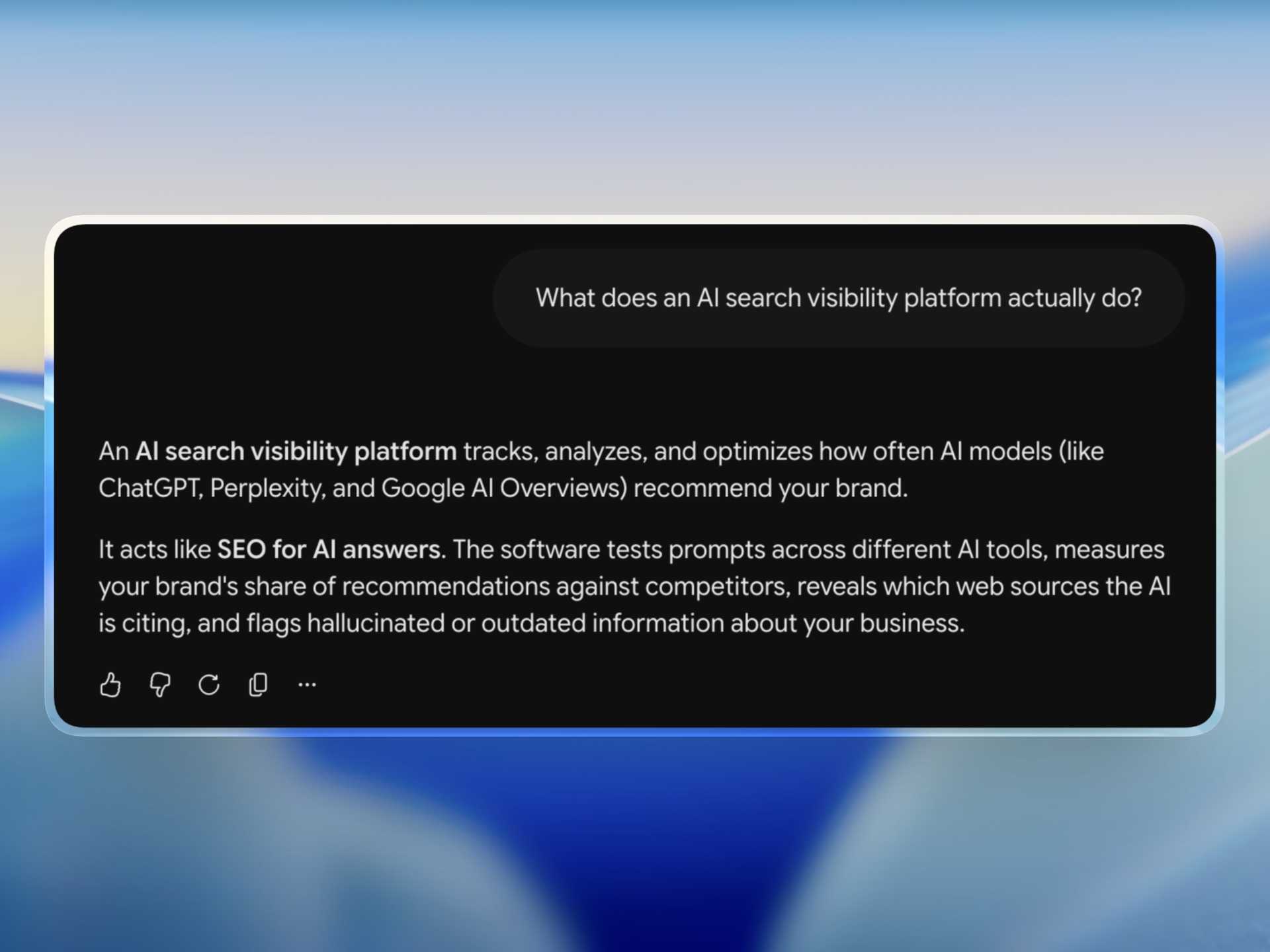
An AI search visibility tool (also called an AI search visibility tracking tool or platform) measures whether your brand is mentioned or cited in those answers, compares competitors on the same prompt set, and turns gaps into actions your team can ship.
It answers a practical question rank trackers miss: when buyers ask ChatGPT, Perplexity, Gemini, Google AI Overviews, or similar surfaces about your category, does your brand show up, and who shows up instead?
If you already know the category and want the product workflow, use the AI search visibility and action platform hub. For a current vendor shortlist, see top AI visibility platforms in 2026. For ChatGPT-only methods, see how to check ChatGPT brand mentions and how to track ChatGPT brand mentions.
Quick answer
| Question | Short answer |
|---|---|
| What is AI search visibility? | Whether your brand appears in Google results and in AI answers for the prompts that matter |
| What is an AI search visibility tool? | Software that tracks brand mentions and citations in AI answers plus Google performance, then compares competitors |
| How do you track AI brand mentions? | Save buyer prompts, re-run them across answer surfaces, and log mentions, citations, competitors, and dates |
| How do you track AI visibility? | Combine Search Console outcomes with repeated AI presence checks on a fixed prompt set |
| How do you compare vs competitors? | Use the same prompts for every brand, then connect mention gaps to pages, citations, and Search Console demand |
| How is it different from SEO tools? | Rank trackers miss who an answer recommends when there is no click |
| Does high page readiness equal visibility? | No. Readiness is an audit. Mentions and citations are measured outcomes |
What is AI search visibility?
AI search visibility is the measurable presence of your brand across two discovery surfaces:
- Classic Google results: rankings, impressions, CTR, and clicks for queries that matter.
- AI-generated answers: mentions and citations on buyer prompts in ChatGPT, Perplexity, Gemini, Google AI Overviews, Copilot, and similar systems.
Your homepage might rank. A competitor might still be the default recommendation in ChatGPT. Your blog might cover the topic without naming the category clearly enough for a model to classify you.
Teams also call this AI visibility, visibility in AI search, or AI search engine visibility. The labels differ. The operating problem is the same: discovery now spans ranked links and synthesized answers.
AI visibility data is the evidence you keep: Search Console clicks and impressions, mention rate, citation rate, competitor appearances, cited domains, and the dates of each check. Without that history, you cannot tell whether a change helped.
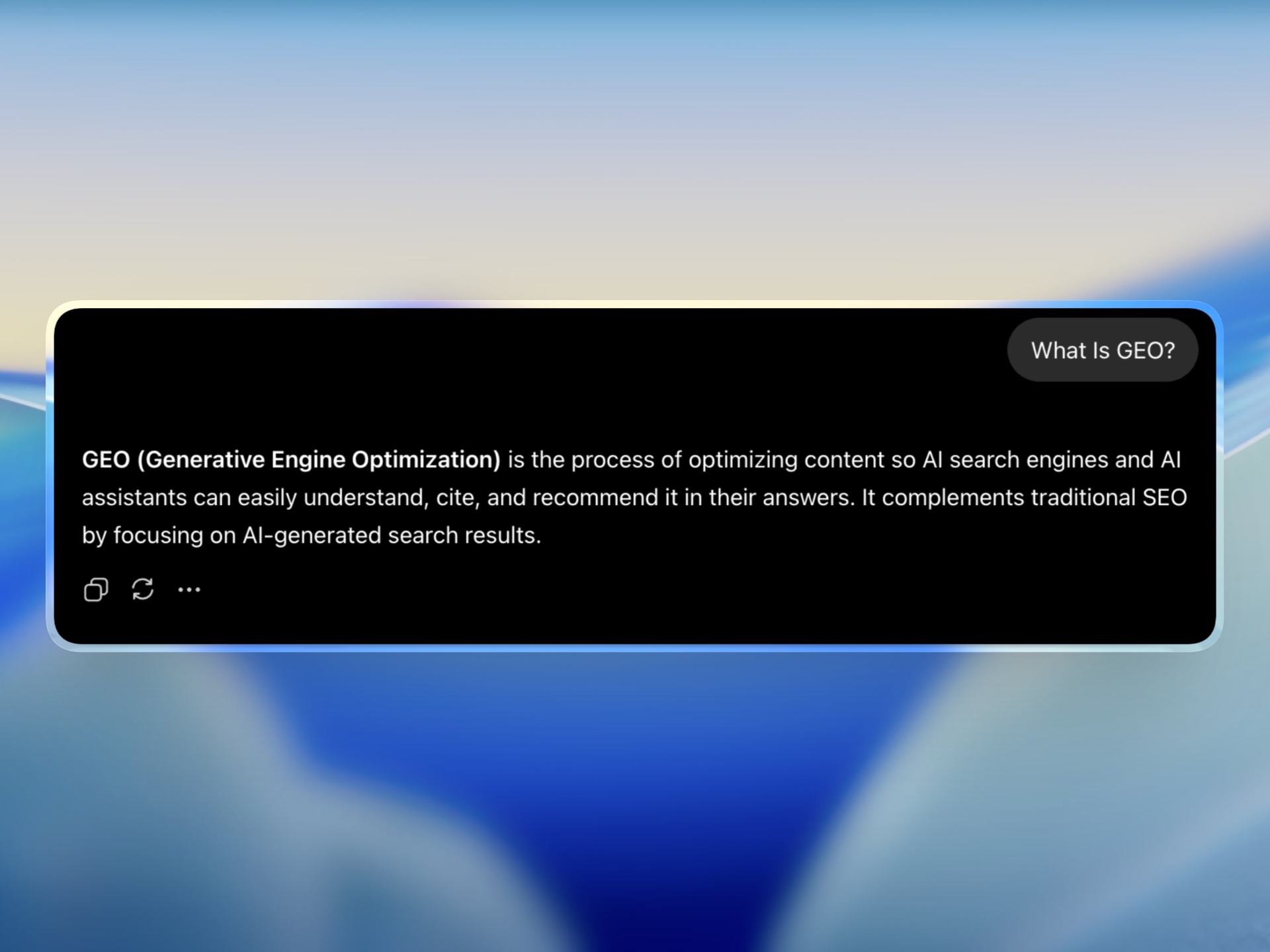
SEO and AI visibility are one system, not two departments. Crawl access, clear entities, extractable answers, and third-party corroboration still matter for both. Treat GEO as the AI-answer side of the same loop, not a replacement for Google fundamentals.
What an AI search visibility tracking tool measures
A useful tool connects five kinds of evidence.
1. Google search performance
Search Console context still matters: which pages earn impressions, which queries convert to clicks, and where titles or intent mismatch waste attention. An AI-only dashboard that ignores Google leaves half the discovery story out.
2. AI presence on buyer prompts
For each saved prompt and provider, record:
- Did the model mention your brand?
- Did it cite one of your URLs?
- Which competitors appeared instead?
- Was the sentiment positive, neutral, or risky?
- Did the result change since the last comparable run?
One prompt is not the whole truth. A monitored set of buyer prompts gives a baseline you can re-run after shipping changes.
3. Citations and third-party sources
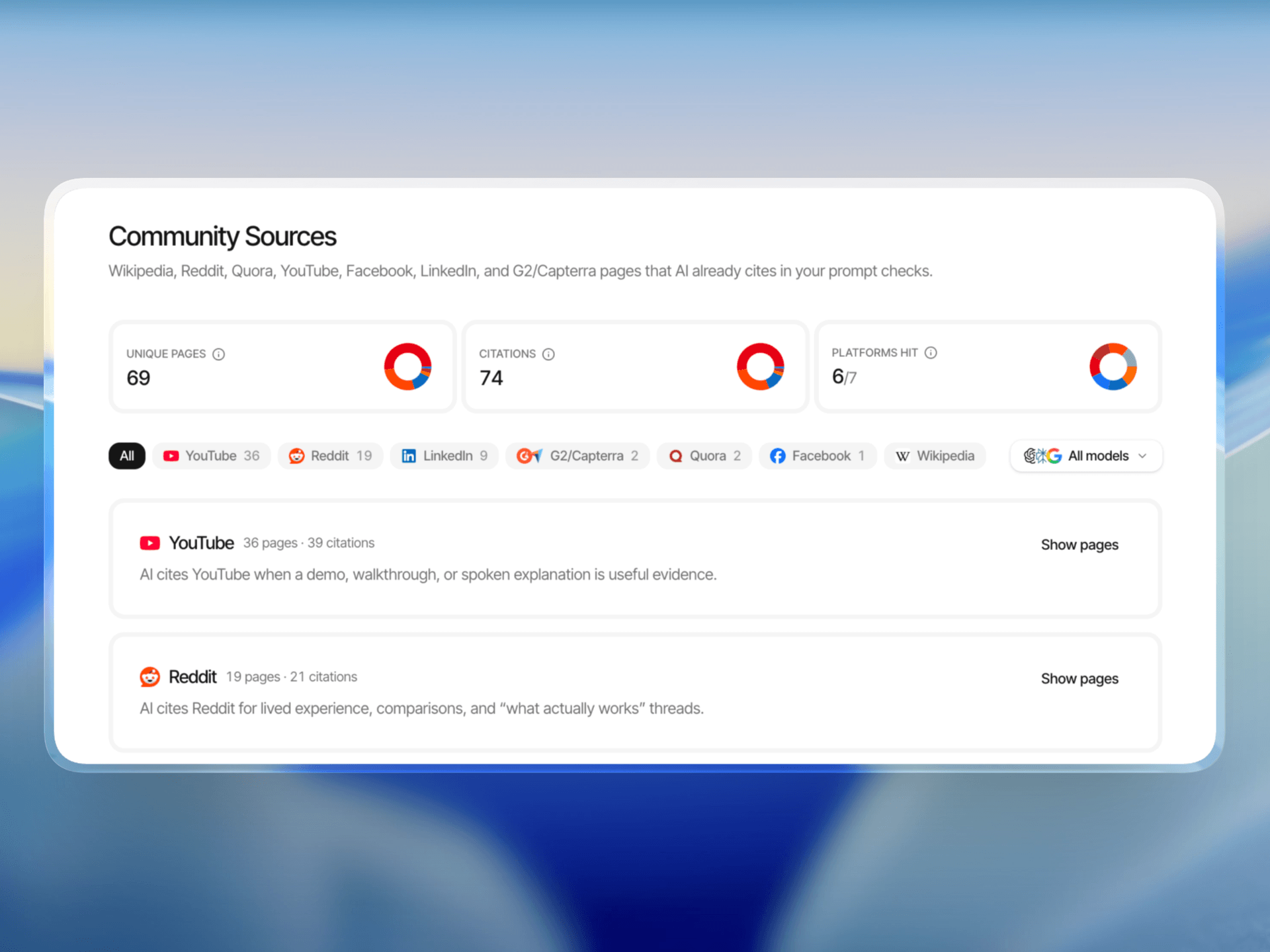
Answers often lean on YouTube, Reddit, review sites, and publishers before they lean on your product page. Expose cited domains so you can see whether the contest is on-site content or off-site corroboration.
4. Page and site readiness
Search engines and AI systems need pages they can parse: clear H1s, useful meta descriptions, FAQ sections with direct answers, schema, trust signals, and crawler access. Readiness scores are audits. They are not measured rankings or measured AI mentions.
5. Competitor gaps that become tasks
Useful gap evidence includes topics competitors cover that you do not (content gap analysis), prompts where they are mentioned and you are absent, URLs that appear as citations, and whether the fix is a page refresh or a new comparison page.
The point is not to copy competitors. The point is to find the missing proof Google and AI systems may need to understand your product.
Core metrics that matter
| Metric | What it means | How to use it |
|---|---|---|
| Mention rate | Share of checks where answer prose names your brand | Baseline for brand presence on a fixed prompt set |
| Citation rate | Share of checks that link your domain as a source | Stronger on citation-heavy surfaces like Perplexity |
| Visibility or share of voice | Weighted presence versus tracked competitors | Shows who the answer treats as the category default |
| Avg mention position | How early your brand appears when named | Useful for prominence, not classic SERP rank |
| Sentiment | Tone when the brand is described | Flags risky or inaccurate framing |
| Search CTR and clicks | Google performance for related queries and pages | Keeps AI actions tied to real search demand |
Do not chase every metric. Pick a small prompt set, a clear Search Console slice, and a short task list. Re-measure the same inputs after you publish.
How to track brand mentions in AI search answers like ChatGPT and Perplexity
How do you track brand mentions in ChatGPT and Perplexity? Save a stable set of buyer prompts, run the same prompts across each answer surface, and record whether your brand appears, which competitors appear, which domains are cited, and when the check ran.
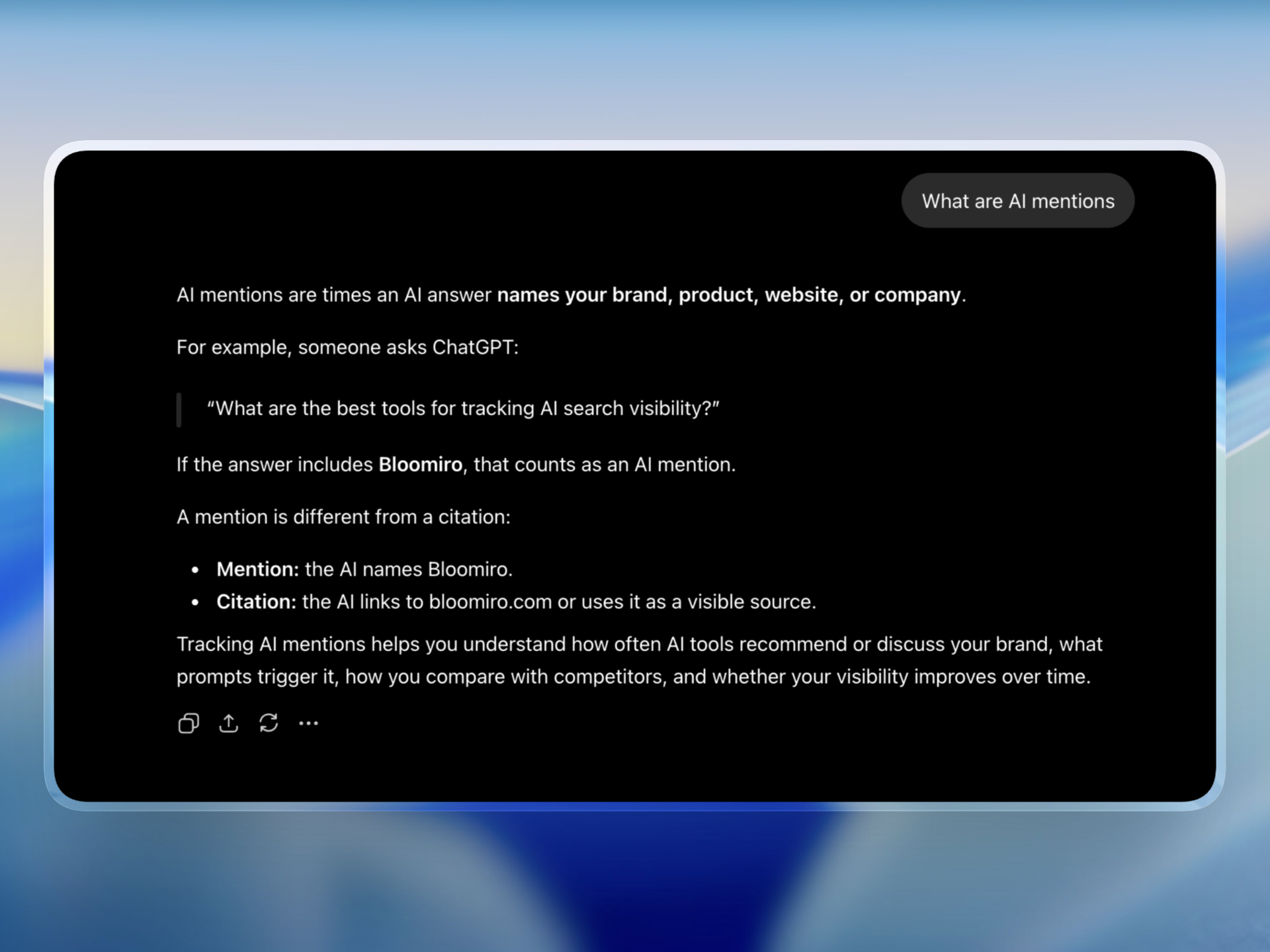
A mention is not the same as a citation:
- Brand mention: the answer prose names your brand
- Brand citation: a cited source URL points to your domain
- Competitor appearance: a tracked competitor is named or represented by a related URL
An answer can name you without linking your site, or cite your docs without naming the company clearly. Track both.
Use this loop:
- Choose 10 to 25 prompts tied to category, problem, comparison, and use-case questions buyers actually ask.
- Prefer discovery prompts over branded ones. Branded prompts mostly test recognition you already handed the model.
- Save the exact wording, providers, and locale so the next run is comparable.
- Store the answer, mention result, citations, competitors, provider, status, and date.
- Review failed checks before interpreting the score.
- Re-run the same set after enough time, or after a meaningful site or distribution change.
Manual spot checks are fine for a one-off screenshot. They are weak for trends, because answers can vary by user, location, session, and model updates. A fixed prompt set is what makes the measurement repeatable.
For the full method, including prompt examples and scoring, read how to track brand mentions in AI search. For surface-specific detail, see ChatGPT brand mentions and Perplexity brand mentions.
Best AI search visibility tool for comparing your brand vs competitors
What is the best AI search visibility tool for comparing your brand vs competitors? The best fit is the tool that runs identical buyer prompts for your brand and competitors, separates mentions from citations, and connects those gaps to pages and Google Search Console demand, not only a vanity share-of-voice chart.
No tool can promise that your brand will become the default answer. Choose on measurement design and shipping workflow.
Use these criteria:
| Capability | Why it matters for brand vs competitor comparison |
|---|---|
| Identical prompt sets | Everyone is judged inside the same generated answer |
| Provider transparency | Separates ChatGPT, Perplexity, Google AI Overviews, and other surfaces |
| Mentions vs citations | A name without a link is not the same as a cited source |
| Competitor entity tracking | Shows who appears instead of you, and how often |
| Cited domains and community sources | Reveals when Reddit, YouTube, or publishers shape the answer |
| Search Console context | Ties AI gaps to real Google demand on related queries |
| Page and content gap evidence | Explains a missing mention with topics and pages, not just a score |
| Task output | Turns the gap into actions you can ship and re-measure |
Broad SEO suites such as Semrush or Ahrefs are strong when you already need keyword research, backlinks, and site audits, and AI visibility is an add-on. Dedicated AI mention trackers are strong when you only need prompt charts. An AI search visibility platform is the better primary buy when you need Google evidence, AI presence, competitor comparison, and prioritized tasks in one loop.
Bloomiro is built for that loop: Search Console performance, AI mentions and citations across buyer prompts, competitor comparison, community sources, and a short task list your team (or agents via MCP) can execute. For vendor shortlists and checklists, see top AI visibility platforms and how to evaluate AI search visibility tools. For the comparison workflow itself, read how to compare your brand with competitors in AI search.
Platform vs tracker vs SEO suite
| Type | Typical strength | Typical gap |
|---|---|---|
| AI mention tracker | Prompt runs and mention charts | Weak Google context and weak shipping workflow |
| Broad SEO suite | Keywords, links, site audits | Limited AI answer history or no prompt-level competitor loop |
| Content optimizer | Rewrites and on-page suggestions | Little proof of AI presence change |
| AI search visibility platform | Mentions, citations, competitors, search context, tasks | Must stay honest about what it cannot guarantee |
If a tool only writes content, it is not enough. If it only tracks ranks, it is not enough. The useful product connects visibility data to decisions and actions.
The simple operating loop
- Save 10 to 25 highest-intent buyer prompts.
- Run AI presence checks across the surfaces your buyers use.
- Pull Search Console for the related pages and queries.
- Compare competitor mentions, citations, and topics.
- Pick the top three tasks by impact, confidence, and effort.
- Prefer improving existing pages over creating new ones.
- Ship updates, then re-measure the same prompts and pages.
Small, repeated fixes beat one giant visibility project. For sequencing when both SEO and GEO look broken, read GEO vs SEO: what to fix first.
Summary
An AI search visibility tool measures whether your brand shows up in Google results and in AI answers for the prompts that matter. It compares competitors on the same prompt set, separates mentions from citations, and turns gaps into prioritized actions.
The goal is simple: make your brand easier to understand, easier to cite, and easier to recommend, without pretending any tool can promise rankings or mentions.
That is what Bloomiro is built for. It gives SaaS teams one workflow to track Google performance, AI mentions, citations, competitors, and the next fix to ship.
Next, review the AI search visibility platform, read AI visibility methodology, or scan your site with the visibility checker.