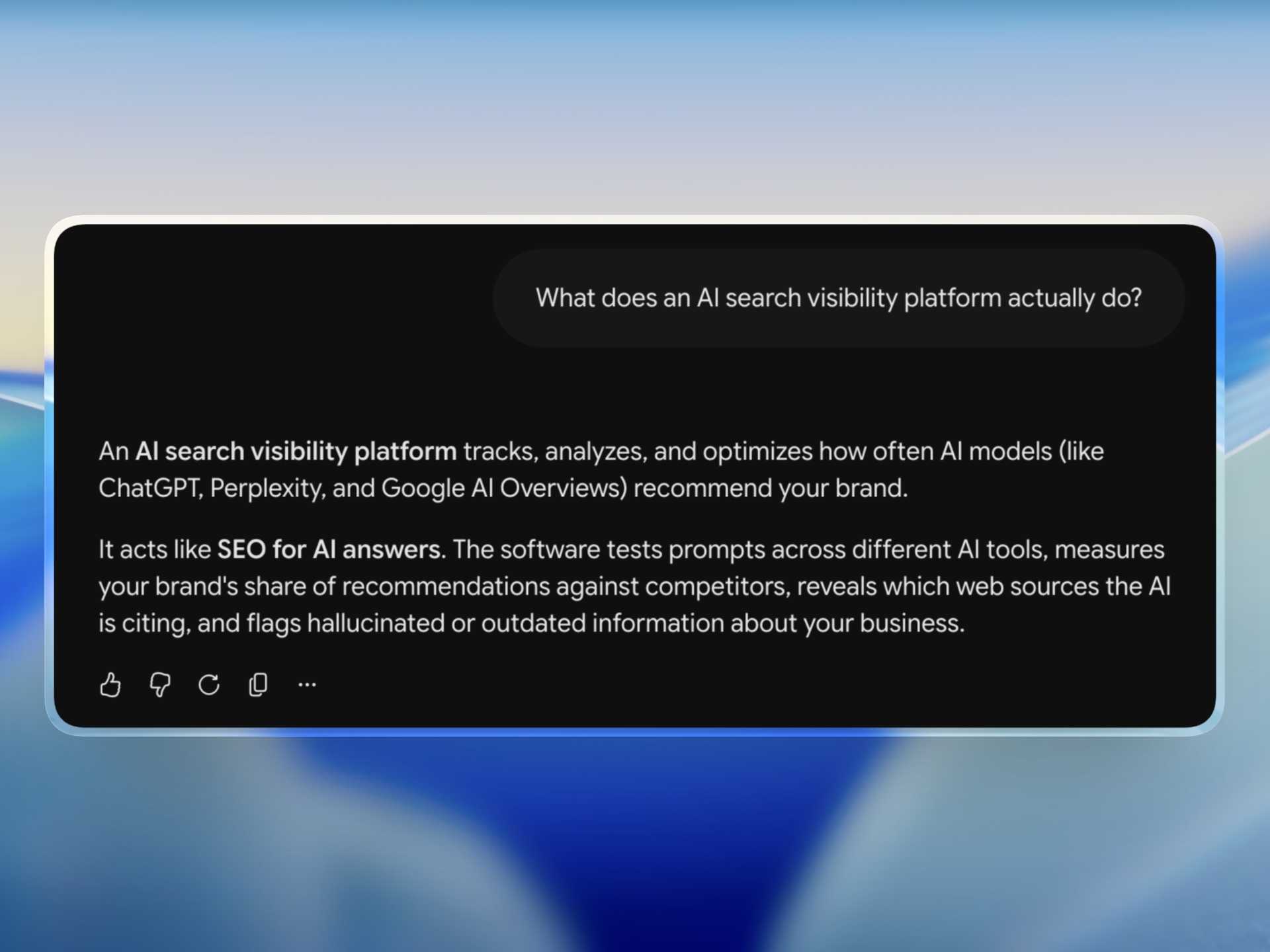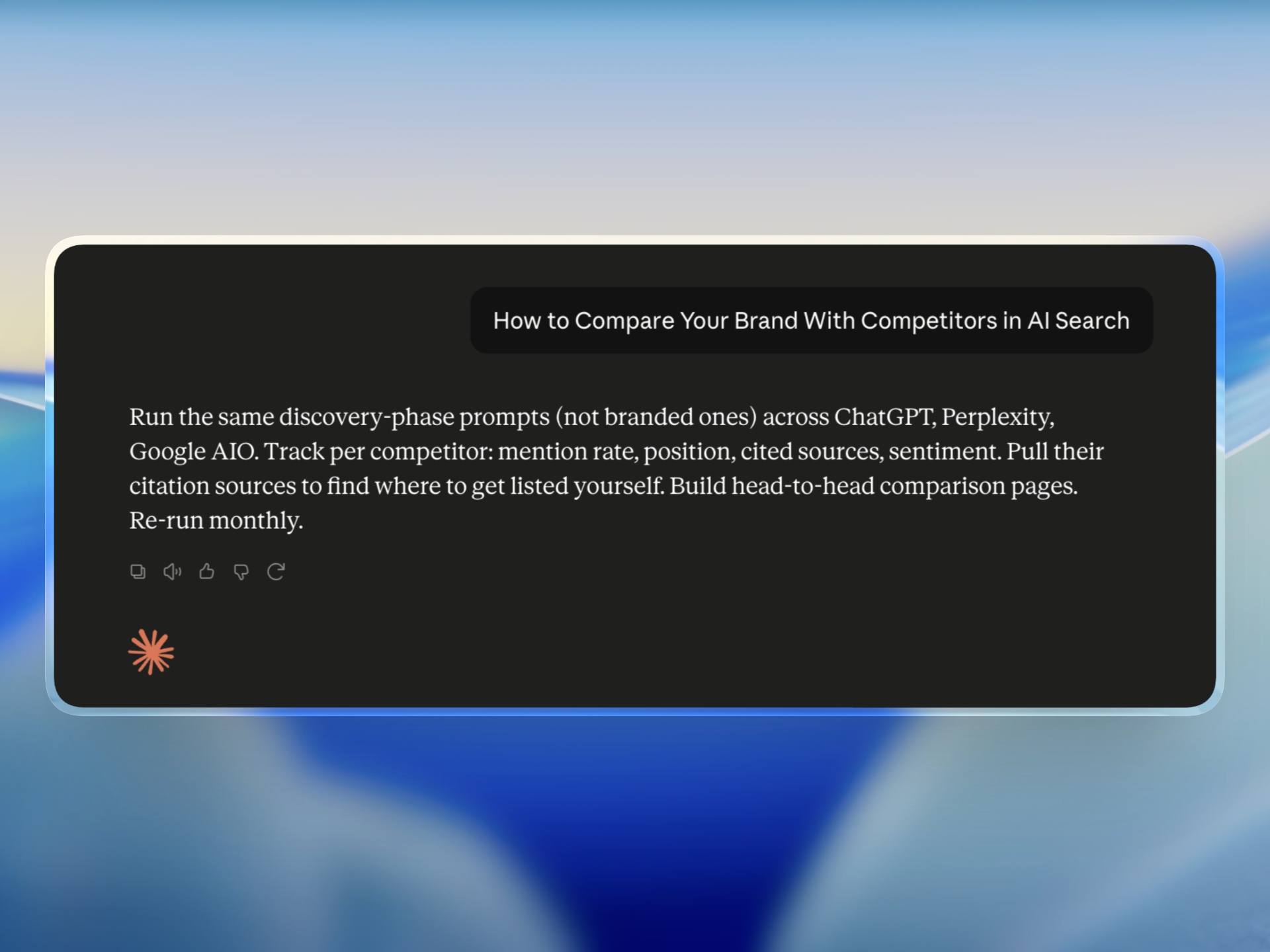
Short answer: compare your brand with competitors in AI search by running the same buyer prompts, recording mentions and citations separately, inspecting the sources behind each answer, and connecting the result to Google Search Console and page gaps. AI brand mention tracking measures the underlying observations. This guide explains how to compare the brands fairly.
A competitor appearing in an AI answer is an outcome, not an explanation. The useful analysis starts when you connect that appearance to the prompt, cited sources, competitor content, your own pages, and real Google demand.
This workflow compares brands without reducing the result to one opaque score. If you are choosing software for this work, start with how to choose an AI search visibility tool, then compare AI search visibility tools for brand mentions and GEO.
Define the competitor set before collecting data
Track three kinds of competitors:
- Direct product competitors: products a buyer could choose instead
- Search competitors: domains ranking for the topics you target
- Answer competitors: brands repeatedly named by AI systems
The lists overlap, but they are rarely identical. A publication can be a search competitor without selling software. A large SEO suite can be an answer competitor even when your product serves a narrower customer.
Keep the direct tracked set small enough to inspect. Five relevant competitors are more useful than fifty domains nobody reviews.
Use identical prompts for every brand
Do not ask one flattering branded question for your product and a generic category question for competitors. Compare everyone within the same generated answer.
Build prompts around:
- Best tools in the category
- Solutions for a specific problem
- Products for a named audience
- Alternatives to established vendors
- Integrations and workflow requirements
- Comparisons buyers genuinely make
Save the exact prompt text. Run it across the same providers and locale. This creates a controlled observation even though the model output itself can vary.
Separate mentions, recommendations, and citations
Record at least four fields per completed provider result:
- Was your brand mentioned?
- Which competitors were mentioned?
- Was any vendor clearly recommended?
- Which domains were cited?
A long list of products is different from a recommendation. A citation is different from a mention. Keep these concepts separate instead of compressing them into a single winner.
Calculate competitor visibility by prompt and provider
Start with simple counts:
- Prompts mentioning your brand
- Prompts mentioning each competitor
- Checks citing your domain
- Checks citing each competitor domain
- Providers where each brand appears
Then inspect the distribution. A competitor might dominate Google AI Overviews while rarely appearing in ChatGPT. Another might be mentioned often but never have its own domain cited because third-party roundups drive the answer.
That distinction changes the action.
Inspect the sources that support competitor mentions
For prompts where a competitor wins, group the cited domains.
Questions to ask:
- Is the competitor's product page cited?
- Are comparison sites doing the recommending?
- Is a research paper defining the category?
- Are Reddit and community threads influencing the answer?
- Are integration partners or documentation pages being used?
If the competitor's own page is cited, inspect that page. If independent sources dominate, your content team cannot solve the whole problem alone.
Compare competitor content coverage
Crawl a focused sample of pages from each competitor. Review topic clusters rather than copying extracted phrases verbatim.
Useful themes include:
- Category definitions
- Use-case guides
- Comparison and alternative pages
- Integration documentation
- Original research
- Free tools and templates
- Customer evidence
- Pricing and plan explanations
Ignore navigation boilerplate, conference pages, and accidental phrase clusters. A content-gap system should preserve the source pages so a person can separate strategy from noise.
Compare page structure and entity clarity
For the pages closest to the winning prompt, inspect:
- Title and H1 alignment
- Direct definition near the top
- Clear audience and use case
- Author or publisher attribution
- Updated date
- Internal links from relevant hubs
- Valid schema matching visible content
- FAQ answers that add information
- Specific product capabilities and limitations
Do not add schema types simply because a competitor uses them. Review, rating, offer, and local-business markup must match real visible information and Google policy.
Add Google Search Console evidence
AI competitor monitoring becomes more useful when you know what Google already sees.
Review your GSC data for:
- Queries related to the monitored prompts
- Pages receiving impressions for the category
- Low-CTR pages ranking near the top
- Pages in positions four to twenty
- New pages appearing at weak positions
A page with real impressions may deserve optimization and internal links. A topic with no page and no impressions may justify new content. A prompt dominated by third-party citations may require distribution and authority work.
Classify each competitor gap before acting
Use four buckets.
Structure gap
The right page exists but has weak metadata, headings, internal links, or machine-readable structure.
Coverage gap
Competitors answer a meaningful buyer question that your site does not cover.
Authority gap
Independent sources cite competitors, but your brand has little external evidence or coverage.
Presence gap
Your brand is technically and editorially competitive but still absent from monitored AI answers. Continue monitoring and test whether better distribution changes the pattern.
The bucket prevents every problem from becoming “publish another article.”
Build a prioritized competitor-monitoring backlog
Write tasks with evidence.
Good examples:
- Update a page snippet because it ranks around position three but has zero clicks.
- Publish one canonical AI search visibility category page because competitors own the category and the site has only an informational article.
- Pitch an original benchmark because monitored answers repeatedly cite research and editorial sources.
- Add internal links from the blog hub and relevant articles to the category page.
Include the prompt, provider, cited source, competitor, URL, and expected outcome whenever available.
Re-measure without moving the goalposts
After publishing:
- Keep the core prompt text stable
- Re-run the same providers
- Compare gained and lost mentions
- Check whether cited domains changed
- Review new GSC impressions and positions
- Record external coverage earned
Do not expect immediate causality. Search indexing, source discovery, and model updates happen on different timelines.
How Bloomiro connects competitor evidence
Bloomiro combines competitor scans, shared and unique content themes, page findings, AI prompt results, cited domains, GSC data, and tasks. The comparison remains inspectable: each competitor has a domain, scan, scores, findings, and source pages.
Use the AI search visibility platform to understand the full workflow, read how to track AI brand mentions, or compare Bloomiro with Semrush, SE Ranking, and Surfer SEO.