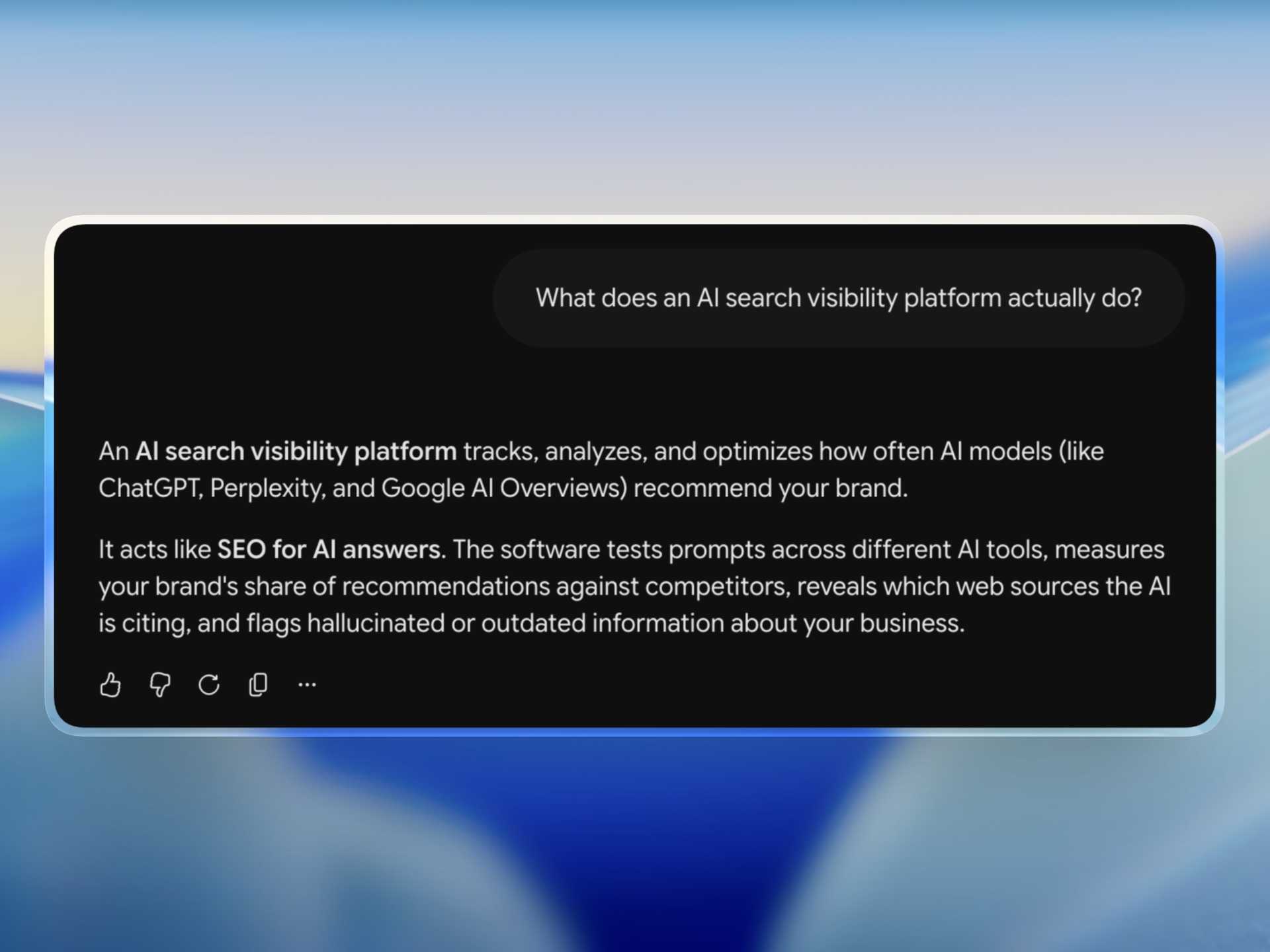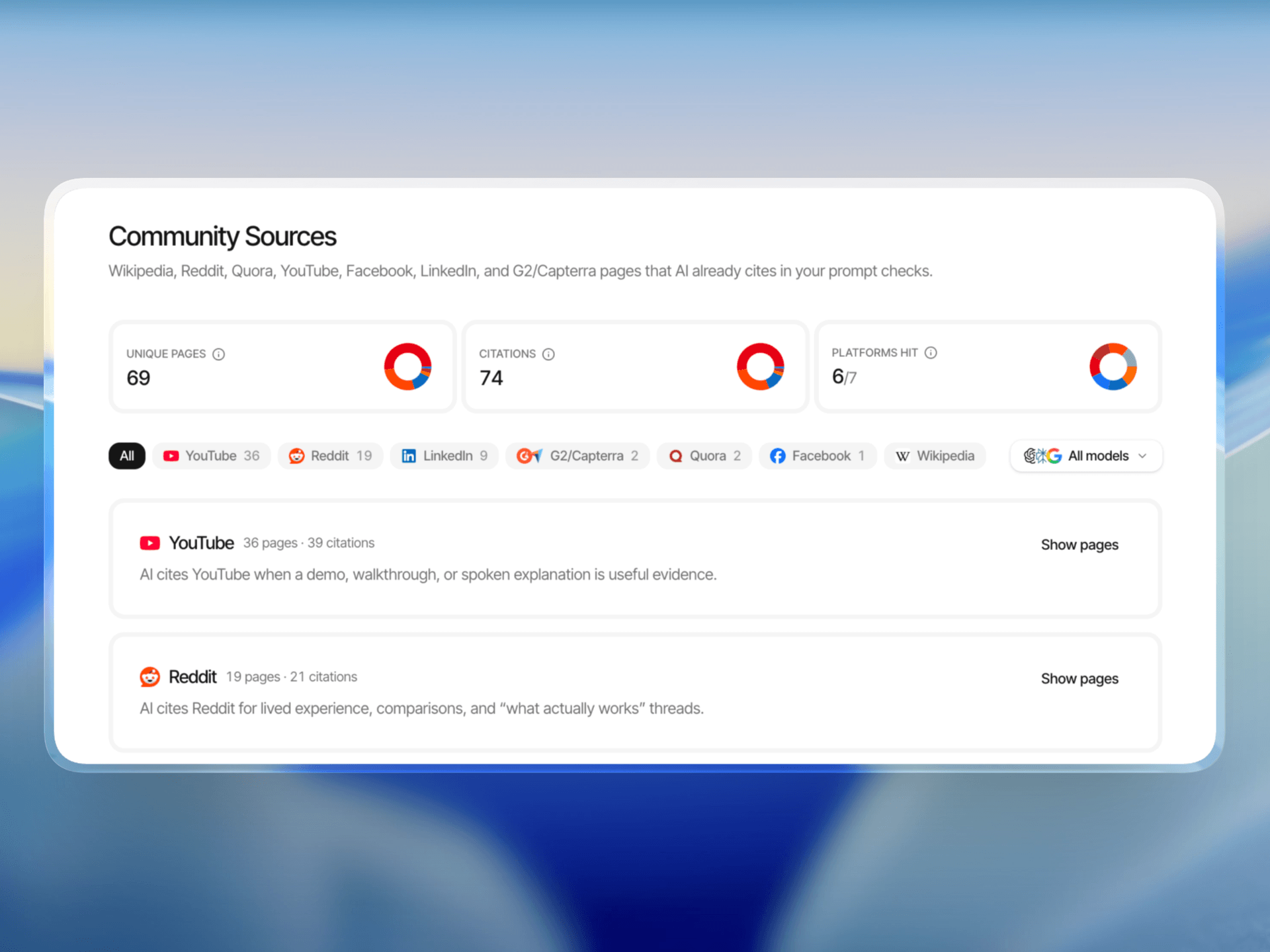
Short answer: track brand mentions in AI search by saving a stable set of buyer prompts, running the same prompts across each answer surface, and recording whether your brand appears, which competitors appear, which domains are cited, and when the check ran. The result is a repeatable observation for your selected prompts, not a promise about every answer a person could receive.
This is the main educational hub for AI brand mention tracking. Use the commercial AI brand mention tracking page when you want the product workflow, then use these focused guides when you need one surface in depth:
| Intent | Go here |
|---|---|
| Track ChatGPT brand mentions | How to track ChatGPT brand mentions |
| Check ChatGPT brand mentions | How to check ChatGPT brand mentions |
| Track mentions in Perplexity | How to track Perplexity brand mentions |
| Check Google AI Overviews | How to check Google AI Overviews brand mentions |
| Category definition | What is AI search visibility? |
| Compare platforms | Top AI visibility platforms in 2026 |
| Compare brand vs competitors | How to compare your brand with competitors in AI search |
| Product workflow | AI search visibility platform |
| Commercial AI brand mention tracking | AI brand mentions |
That is also how you track AI visibility in practice: Google Search Console for clicks and impressions, plus repeated AI presence checks for mentions and citations. Keep both. One without the other is incomplete AI visibility data.
Repeat the same measurement later without changing the prompt set or provider mix. That gives you comparable observations. It does not give you universal AI market share, because generated answers can vary between users, locations, sessions, and model updates.
What is an AI brand mention?
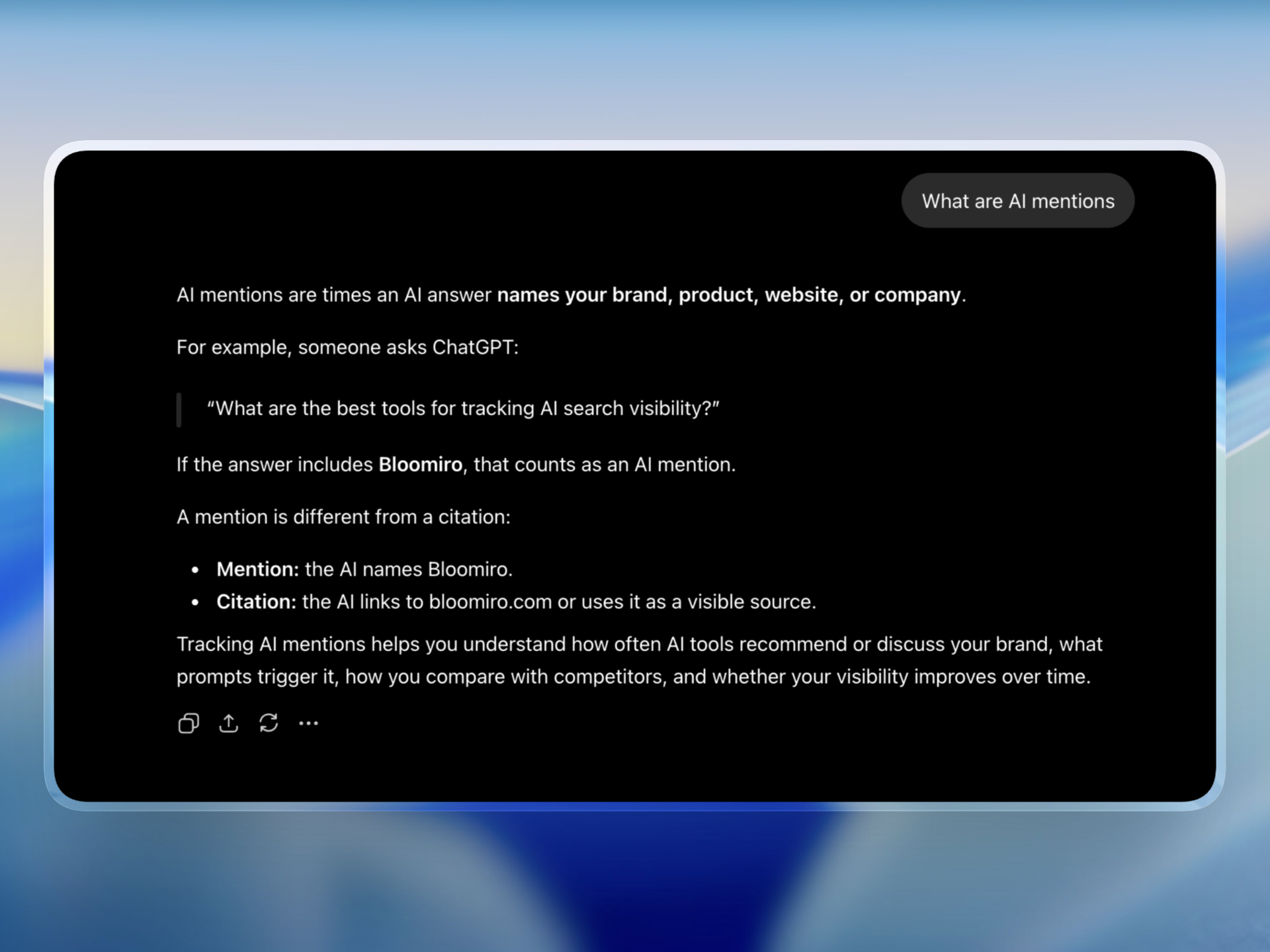
An AI brand mention occurs when a generated answer names a company, product, or recognized brand variation in its answer prose.
A mention is not the same as a citation:
- Brand mention: the answer prose names your brand
- Brand citation: a cited source URL points to your domain or a subdomain
- Competitor appearance: a tracked competitor is named in the answer or represented by a related cited or inline URL
- Cited source: a source URL used to support the generated answer
An answer can mention your company without citing your site. It can also cite your documentation without naming the company clearly. Keep both fields instead of combining them into one yes-or-no result.
The short answer: how to track AI brand mentions
Use this workflow:
- Choose 10 to 25 prompts tied to real category, problem, comparison, use-case, and integration questions.
- Save the exact wording so it can be reused.
- Select the AI answer surfaces and one language and country scope.
- Run every prompt across the same provider set.
- Store the answer, mention result, citations, competitors, status, provider, and date.
- Review failed checks before interpreting the score.
- Repeat the run with the same scope after enough time or after a meaningful site, product, or distribution change.
The discipline matters more than the dashboard. If the prompt text, locale, or provider mix changes every time, the trend is measuring a moving target.
Build prompts around buyer decisions, not your brand name
Branded prompts mostly test whether an AI system recognizes an entity it was explicitly given. Discovery prompts test whether the brand appears without being handed to the model.
Use a balanced set.
Category discovery prompts
- Best AI search visibility tools for a SaaS company
- Software for monitoring brand mentions in AI answers
- Platforms that combine Google and AI visibility data
Problem-aware prompts
- How can I tell whether ChatGPT mentions my company?
- How do I find the sources Perplexity cites in my category?
- How should a small marketing team measure GEO performance?
Comparison and alternative prompts
- Alternatives to an established vendor for a specific use case
- Dedicated AI visibility platform versus a traditional SEO suite
- Best tools for comparing brand mentions with named competitors
Use-case and integration prompts
- AI visibility monitoring for a small SaaS team
- Brand mention tracking for an SEO agency
- AI visibility platform with Google Search Console and MCP
Specific prompts are more useful than hundreds of lightly rewritten variations. Save a stable core and add new prompts deliberately instead of replacing the benchmark on every run.
How to track brand mentions in ChatGPT
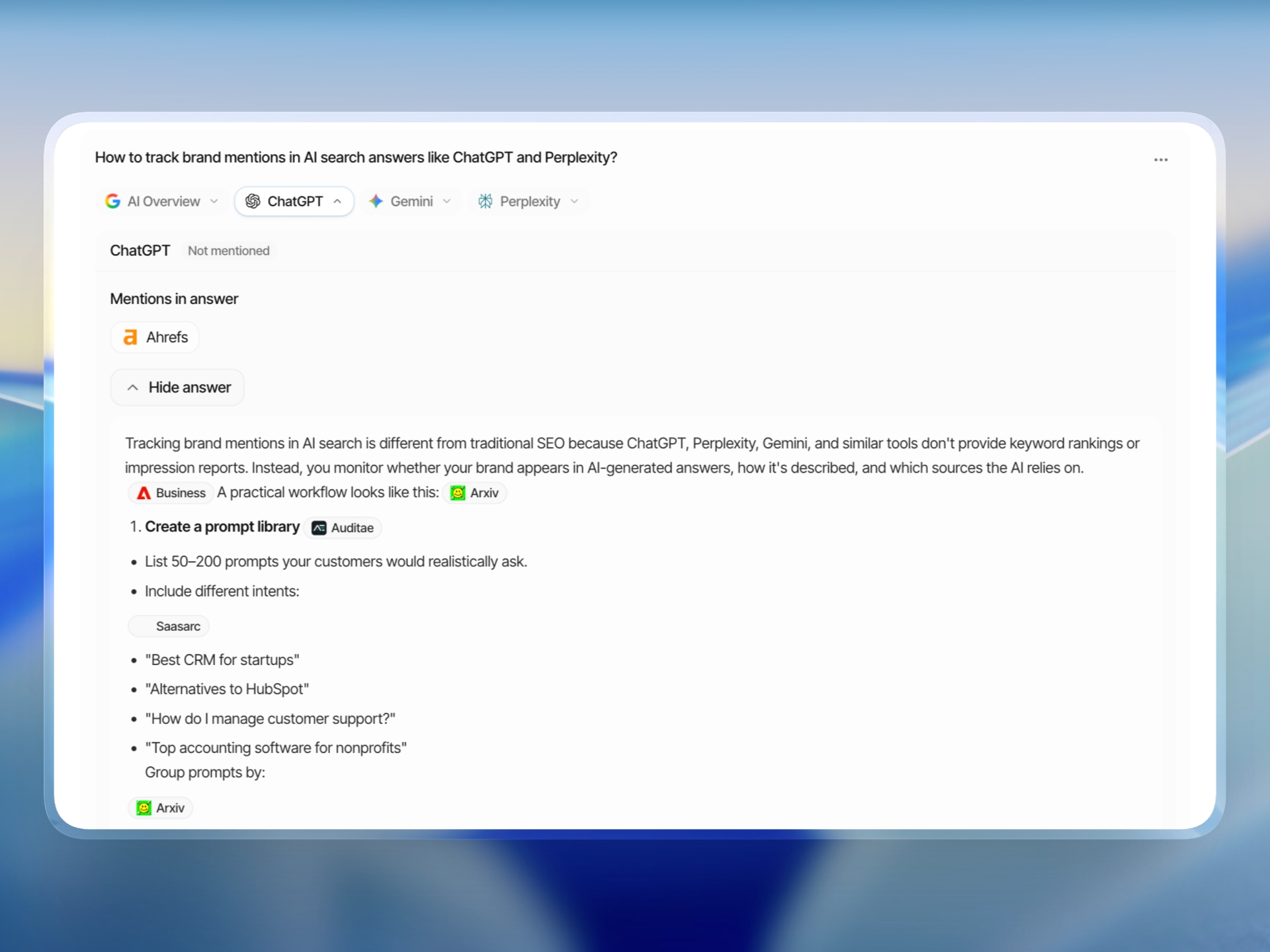
For ChatGPT monitoring, use the same exact prompt wording each time and record whether the returned answer names the brand in prose. Save any cited source URLs separately.
For example, consider this prompt:
What are the best AI visibility tools for a small SaaS team?
Record the result as a structured observation:
| Field | Example value |
|---|---|
| Provider | ChatGPT |
| Prompt | What are the best AI visibility tools for a small SaaS team? |
| Brand mentioned | Yes or no |
| Competitors | Exact tracked competitors found in the answer |
| Brand cited | Yes or no |
| Cited domains | The source hostnames returned with the answer |
| Checked at | Timestamp of the observation |
Do not count the brand simply because its URL appears in a source list. A prose mention and a citation answer different questions.
ChatGPT answers can change even when the prompt stays identical. One response is a snapshot. Repeated observations with a controlled prompt set can reveal patterns, but they cannot describe every answer every ChatGPT user receives.
How to track brand mentions in Perplexity
Perplexity makes source analysis especially useful because citations are central to the answer experience. Capture the cited URLs alongside the prose result, then ask two separate questions:
- Did Perplexity name the brand in its answer?
- Did Perplexity cite the brand's own domain?
A third-party publication may support a brand mention while the brand's own site is never cited. The reverse can also happen when a documentation page is cited without a clear prose mention.
For a prompt such as:
Which tools track brand mentions across ChatGPT and Perplexity?
inspect the source pattern, not only the product list. Repeated citations to directories, research, documentation, reviews, or comparison pages tell you what kind of evidence the answer is using.
Do not assume a cited domain caused the recommendation. Citation data shows association inside the captured answer, not a complete explanation of Perplexity's ranking or generation process.
Track Google AI, Gemini, and Copilot with the same structure
The same observation model works across Google AI Overview, Google AI Mode, Gemini, and Microsoft Copilot:
- Exact saved prompt
- Provider surface
- Prompt-group locale
- Completed or failed status
- Brand mention in answer prose
- Tracked competitor appearances
- Cited source URLs when available
- Check timestamp
Provider results should stay separate. A combined percentage can hide that a brand appears consistently in one surface and never appears in another.
A worked AI mention-tracking example
Suppose a company tracks five prompts across ChatGPT and Perplexity. Ten prompt-by-provider checks are possible.
The run completes with this hypothetical result:
| Prompt | ChatGPT | Perplexity |
|---|---|---|
| Best tools in the category | Mentioned | Not mentioned |
| Tool for a small SaaS team | Mentioned | Mentioned and cited |
| Alternative to a known vendor | Not mentioned | Not mentioned |
| Platform with a required integration | Failed | Mentioned |
| How to solve the core problem | Not mentioned | Not mentioned |
The calculations are:
- Mention rate: 4 mentioning checks ÷ 9 completed checks = 44.44 percent
- Prompt visibility: 3 prompts with at least one completed mention ÷ 5 selected prompts = 60 percent
- Brand citations: 1 completed check cited the brand at least once
The failed ChatGPT check is excluded from mention rate because it is not a completed observation. The selected prompt still remains in the visibility-score denominator. That distinction matters when a run has provider failures.
Use a documented AI visibility methodology
A defensible methodology explains exactly how prompts, mentions, citations, failures, providers, and scores are handled.
Bloomiro uses these definitions:
- A prose mention requires a recognized brand-name alias in the answer text.
- Raw URLs, known citation targets, bare tracked domains, and trailing source sections are removed before prose mention detection.
- A brand citation requires a cited hostname matching the project domain or a subdomain.
- Visibility score measures selected prompts with at least one completed mention.
- Mention rate measures completed prompt-by-provider checks with a mention.
- Sentiment is calculated only for detected mentions with a valid result.
- Changes compare with the previous completed run in the same prompt-group scope.
Read the complete AI visibility methodology for formulas, supported answer surfaces, locale behavior, failed-check treatment, update frequency, and limitations.
Compare AI brand-monitoring tools by the evidence they preserve
The right tool depends on whether you need an occasional answer check, a repeatable benchmark, broader media coverage, SEO context, or an implementation workflow.
| Approach | Best for | What it captures | Main limitation |
|---|---|---|---|
| Manual ChatGPT and Perplexity checks | Fast qualitative research | Visible answers and sources you copy manually | Hard to repeat consistently or compare at scale |
| Spreadsheet with manual checks | Small controlled benchmarks | Prompt, provider, mention, citation, date, and notes | Collection and quality control remain manual |
| Traditional brand-monitoring software | News, social, web, and media coverage | Public mentions outside generated answers | May not reproduce prompt-level AI answers |
| Traditional SEO platform | Rankings, keywords, backlinks, and site performance | Search demand and website authority signals | AI answer methodology and provider detail vary by product |
| Dedicated AI visibility platform | Repeated prompt and provider monitoring | Mentions, citations, competitors, answers, and history | Scores depend on the chosen prompt and provider set |
| Bloomiro | AI monitoring connected to SEO execution | Saved prompts, six supported answer surfaces, citations, competitors, GSC, scans, tasks, and MCP | It is not a complete web index, backlink database, or automatic daily AI run scheduler |
Before choosing software, ask to see the exact prompt, provider result, failure status, citation list, scoring formula, and previous run used for comparison. An unexplained score is difficult to audit and even harder to act on.
Read cited domains before publishing more content
When a brand is missing, publishing another landing page is not always the answer. Group the cited sources first:
- Vendor product pages
- Comparison and directory sites
- Editorial publications
- Research papers
- Community discussions
- Documentation and integration pages
If independent research and editorial comparisons dominate, stronger homepage copy alone may not close the gap. The missing work may be original evidence, partner documentation, independently earned reviews, or credible third-party coverage.
If provider answers cite detailed first-party guides, a direct, well-structured explanation may be the right next page. The source pattern helps classify the problem before work begins.
Turn AI mention gaps into specific actions
| Evidence | Possible action to investigate |
|---|---|
| Competitors have category pages and you do not | Publish one accurate canonical category page |
| Your relevant page gets impressions but weak CTR | Test a clearer title and description |
| Answers cite third-party roundups | Build evidence and pursue legitimate independent inclusion |
| Answers cite detailed guides | Publish a stronger, sourceable explanation if you have something useful to add |
| Your brand appears but your site is never cited | Improve owned evidence, documentation, and entity clarity |
| One provider remains different | Inspect that provider's answers and cited-source pattern before generalizing |
These are investigation paths, not causal promises. A new page, citation, or title change cannot guarantee a future AI mention.
Recheck on a cadence you control
Choose a cadence that matches the decision. Weekly or biweekly checks can be useful for high-intent prompts in an active category. Monthly checks may be enough for broader research prompts.
Bloomiro's current AI presence runs are user-triggered from the dashboard or MCP. They do not start automatically on a fixed daily or weekly schedule.
For comparable runs:
- Keep the core prompt text stable.
- Use the same provider set and locale.
- Review completed and failed checks.
- Compare gained and lost mentions.
- Inspect changes in cited domains and competitors.
- Record meaningful site, product, and distribution changes between runs.
Change a small number of things at once. Publishing ten rushed pages makes it difficult to learn which action, if any, was associated with a later result.
Limitations of ChatGPT and Perplexity mention tracking
- Generated answers vary: the same provider can return a different answer for the same prompt.
- One check is one response: it is not a sample of every possible output.
- Prompt sets are selective: results describe the prompts you chose, not all buyer questions.
- No audience weighting: a prompt is not weighted by traffic, revenue, search volume, or real usage frequency.
- Provider systems change: models, retrieval, interfaces, and experiments can change without notice.
- Citation formats differ: not every provider exposes sources in the same structure.
- Alias matching is imperfect: short or ambiguous brand names need manual review.
- Locale controls differ: language and country settings may not affect every provider equally.
- Small changes are not causal proof: a gained mention does not prove one site edit caused it.
- Monitoring cannot guarantee visibility: no tool can promise future mentions, citations, recommendations, rankings, or revenue.
Use the score to find answers worth reading. The answer, sources, prompt, provider, and status are the evidence needed to decide what to do next.
How Bloomiro tracks AI brand mentions
Bloomiro stores exact prompts in groups, runs selected prompts across ChatGPT, Gemini, Perplexity, Google AI Overview, Google AI Mode, and Microsoft Copilot, then records mentions, tracked competitors, cited sources, answer previews, statuses, and run history.
The product connects that evidence with Google Search Console, site and page scans, competitor research, tasks, and MCP. A missing mention can be investigated alongside the pages already receiving search impressions and the sources supporting competitor appearances.
Start with the AI visibility methodology, the focused guides for ChatGPT brand mentions and Perplexity brand mentions, the What is GEO? explainer, the broader AI search visibility platform, or the free site visibility check before building a prompt benchmark.