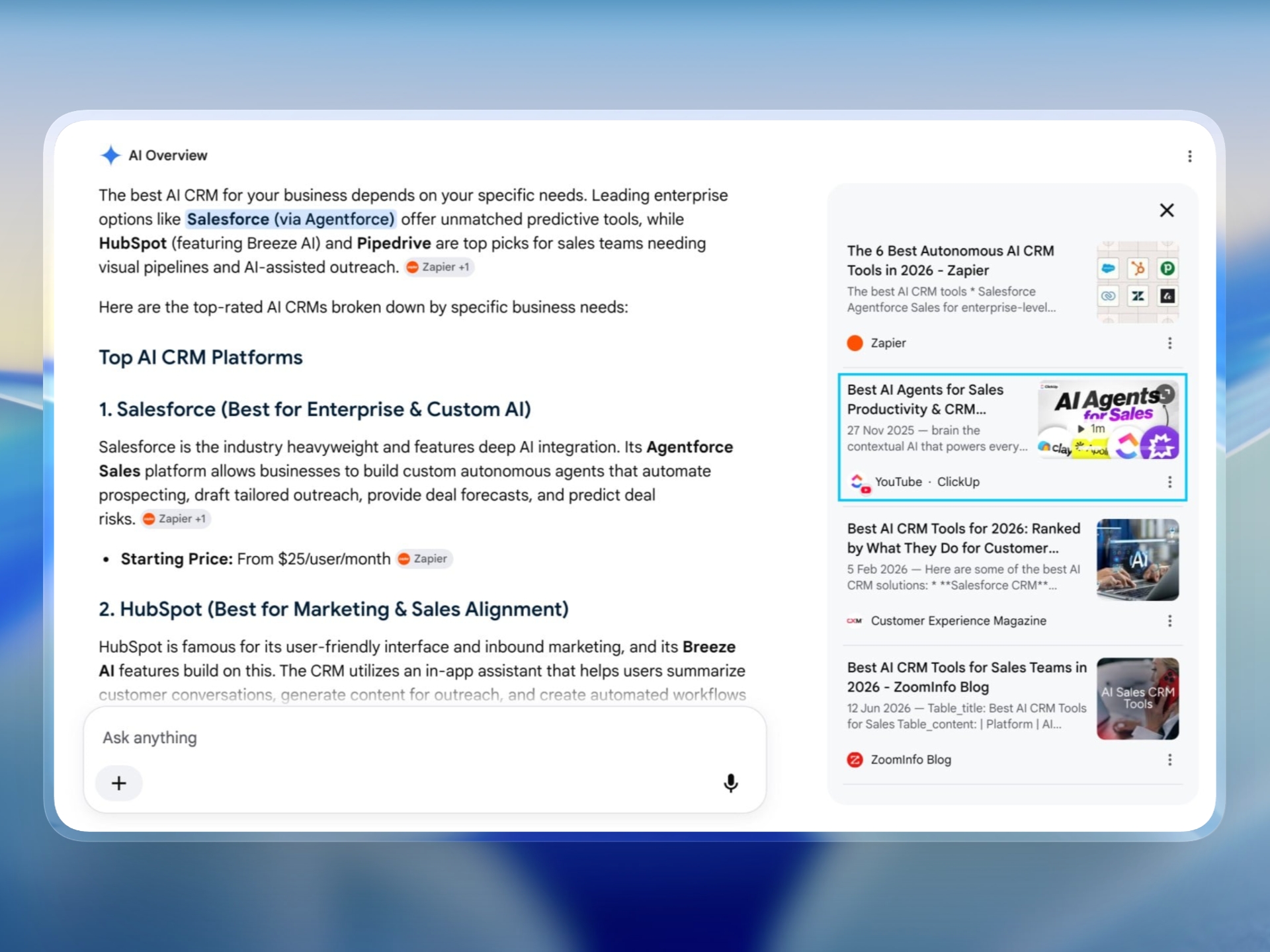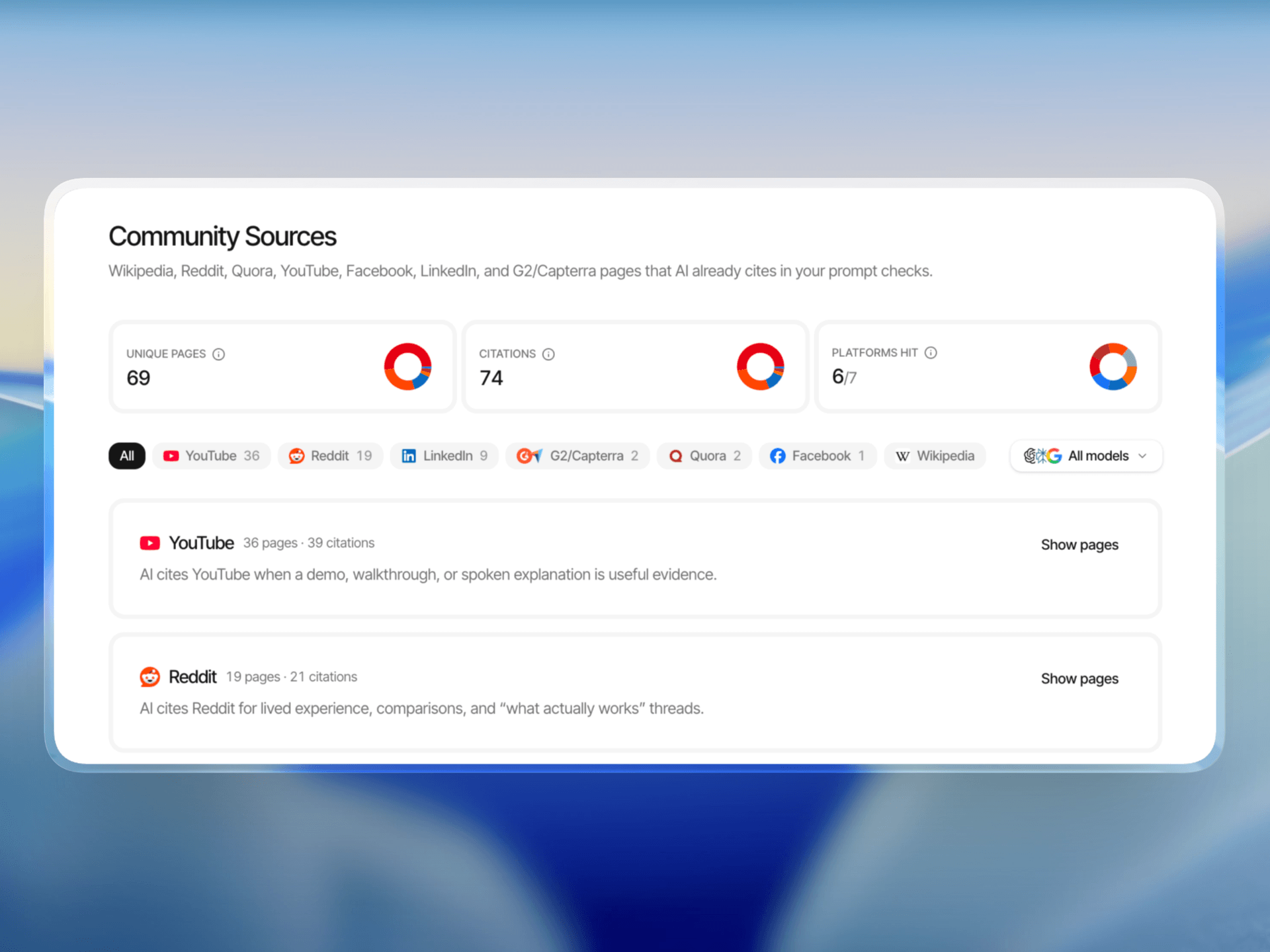
What is the difference between a mention, a citation, position, and share of voice? A mention means the answer text names you. A citation means the answer uses a URL on your domain as a source. Position is where your name sits inside that answer, if the product records it. Share of voice is your mentions divided by all brand mentions in a set of answers. They are four measurements. A single "visibility score" usually hides which one moved.
If you only remember one thing: do not celebrate a mention while a competitor owns the citation, and do not mourn a missing mention on a page Google already ranks.
The four fields
| Metric | Plain meaning | A trap |
|---|---|---|
| Mention | Your brand string appears in the answer | A passing name in a list of ten is not a recommendation |
| Citation | A source link is on your domain | The link can be a blog post you did not mean to be the canonical page |
| Position | How early or how prominently you appear in that answer | This is not your Google organic position |
| Share of voice | Your mentions as a share of tracked brand mentions on those prompts | Useless if the prompt set is vanity queries about your own name |
Google's organic position lives in Search Console. Average position 8 with 15 impressions is a Google fact. "Position 2 inside an AI answer" is a different fact. The page AI answer position matters more than a mention is about the second one. Keep the columns apart.
How to compute share of voice without cheating
Pick the prompts first. Use non-branded buyer questions. Then:
Share of voice = times you were mentioned / times any tracked brand was mentioned, on that prompt set, on that engine, in that date range.
If you add your brand name to every prompt, share of voice goes up and you learned nothing. If you change the prompts mid-month, you cannot compare months.
Bloomiro stores mention and citation as separate fields on a run. The rules are in the AI visibility methodology.
Which metric to act on
- No mention, no citation, and a competitor's docs are cited. You are not the source. Read their page. Decide if you can say something they did not, on a URL you control.
- Mention, no citation. The model knows the name and trusts someone else's URL. Earning the citation is the experiment, not another brand mention in your footer.
- Citation, no mention. Rare, and useful. You are supporting material. Make the page's first sentences say the brand and the answer together.
- Strong share of voice on branded prompts only. That is navigational. Look at non-branded prompts before you report it up.
Our citation study is the cautionary version for Google's AI Overviews: citations versus organic rankings. Being in the blue links did not mean being the cited source.
A reporting sentence that stays honest
"On 12 buyer prompts in Perplexity this week, we were mentioned on 3, cited on 1, and a competitor was cited on 7. In Search Console the closest query has impressions and sits on page two."
That sentence can be checked. "AI visibility improved 14%" cannot, unless you attach the definition.
Related: track brand mentions across engines, Perplexity, where citations are obvious.